
Summary: Master 20 essential Korean expressions frequently used in K-dramas to achieve basic conversational skills. As of 2026, approximately 82 million people worldwide speak Korean, and the Korean language learning market — valued at an estimated $8.9 billion in 2026 — is projected to reach $67 billion by 2034, growing at an annual rate of 25.1%.
1. Why Learn Korean Through K-Dramas?
K-dramas have become the most effective tool to learn Korean with K-drama expressions as of 2026. Korean language enrollment at U.S. colleges surged 78% between 2009 and 2021, with 80% of students citing K-dramas and K-pop as their primary motivation. The momentum hasn’t slowed — in 2026, Netflix’s Korean drama slate alone has delivered over 60 new titles in the first half of the year, from the globally trending ‘Can This Love Be Translated?’ to genre-bending hits like ‘The Scarecrow.’
Unlike textbooks, learning through dramas provides real conversational contexts, emotional expressions, and cultural nuances simultaneously. According to Duolingo’s 2025 Language Report, Korean climbed to the 6th most-studied language on the platform globally, surpassing Italian, with over 1.9 million active learners. In July 2026, Duolingo announced a major overhaul of its Korean course, adding advanced B1/B2 content and expanding availability to speakers of 27 different languages.
Three Core Advantages of K-Drama Learning:
1. Natural pronunciation and intonation become second nature. Unlike formal textbook sentences, dramas showcase the actual speed and rhythm native Koreans use in everyday conversations.
2. Context-based expression learning enhances comprehension. The same phrase carries different meanings depending on the situation, and dramas provide visual cues that textbooks cannot.
3. Cultural immersion happens organically. You’ll naturally absorb honorific language usage, dining etiquette, and social interactions without explicit instruction.
2. Greetings and Basic Courtesy (5 Expressions)
In Korean culture, greetings express the nature of your relationship with others. Here are the five most frequently appearing basic greeting expressions to learn Korean with K-drama contexts.

1. 안녕하세요 (Annyeonghaseyo) – “Hello” / The most fundamental greeting usable morning, noon, and night. In ‘Crash Landing on You,’ this is Yoon Se-ri’s first greeting when meeting North Korean villagers.
2. 감사합니다 / 고마워요 (Gamsahamnida / Gomawoyo) – “Thank you” / Gamsahamnida is formal and polite, while Gomawoyo is casual for close relationships. Attorney Woo Young-woo frequently uses this in ‘Extraordinary Attorney Woo’ with colleagues.
3. 죄송합니다 / 미안해요 (Joesonghamnida / Mianhaeyo) – “I’m sorry” / Joesonghamnida is a formal apology, Mianhaeyo for everyday situations. Students in ‘Sky Castle’ use this when apologizing to teachers for mistakes.
4. 잘 지냈어요? (Jal jinaesseoyo?) – “How have you been?” / Used when meeting friends or acquaintances after some time. In 2026’s hit romance ‘Can This Love Be Translated?,’ interpreter Joo Ho-jin (Kim Seon-ho) and actress Cha Mu-hee (Go Youn-jung) exchange this greeting in their emotionally charged reunion scenes.
5. 수고하셨습니다 (Sugohasyeotseumnida) – “Thank you for your hard work” / Essential in Korean workplace culture. In the 2026 tvN hit ‘See You at Work Tomorrow,’ colleagues exchange this greeting at the end of every workday — a ritual deeply embedded in Korean office life.
3. Emotions and Reactions (5 Expressions)
Emotional expression forms the heart of drama dialogue. Korean offers rich vocabulary and nuanced expressions for emotions, and using them naturally is key to conversational fluency.
1. 정말요? / 진짜요? (Jeongmallyo? / Jinjjayo?) – “Really?” / Expresses surprise or confirmation. Park Seo-joon frequently uses this when surprised by Park Min-young’s statements in ‘What’s Wrong with Secretary Kim.’
2. 대박! (Daebak!) – “Awesome! / Amazing!” / A modern Korean exclamation expressing positive surprise. Characters in ‘Reply 1988’ shout this when something good happens, and it remains one of the most-used slang words in 2026 K-dramas.
3. 힘들어요 (Himdeureoyo) – “It’s hard / I’m tired” / Expresses physical or mental difficulty. In the 2026 slice-of-life drama ‘We Are All Trying Here,’ characters share this sentiment as they navigate career setbacks and self-doubt — a deeply relatable expression for anyone learning a new language.
4. 괜찮아요 (Gwaenchanayo) – “It’s okay / I’m fine” / Reassures others or describes your own state. Gong Yoo frequently uses this to comfort Kim Go-eun in ‘Goblin.’ You’ll also hear it throughout ‘Yumi’s Cells’ Season 3 (2026), where Kim Go-eun’s character navigates her mid-30s with characteristic resilience.
5. 좋아요! / 너무 좋아요! (Johayo! / Neomu johayo!) – “I like it! / I love it!” / Expresses positive emotions and agreement. Son Ye-jin uses this when enjoying new foods in ‘Crash Landing on You.’
4. Daily Conversation Essentials (5 Expressions)
These expressions appear repeatedly in everyday drama scenes. Master these to learn Korean with K-drama efficiency and handle basic conversations.
1. 이거 주세요 (Igeo juseyo) – “Please give me this” / The most practical expression for ordering at restaurants or stores. Yoon Doo-joon uses this in every episode when ordering at restaurants in ‘Let’s Eat.’
2. 잠깐만요 (Jamkkanmanyo) – “Just a moment” / Used to make someone wait briefly or stop. Kim Go-eun frequently uses this when calling Gong Yoo in ‘Guardian: The Lonely and Great God.’
3. 다시 말해 주세요 (Dasi malhae juseyo) – “Please say it again” / Politely requests repetition when you didn’t catch something. In ‘Can This Love Be Translated?’ (2026), interpreter Joo Ho-jin uses this sparingly — but when he does, it signals a pivotal emotional moment where language and feeling converge.
4. 화장실 어디예요? (Hwajangsil eodiyeyo?) – “Where is the bathroom?” / The most essential practical expression for travel or daily life. This basic question appears in virtually every drama.
5. 천천히 말해 주세요 (Cheoncheonhi malhae juseyo) – “Please speak slowly” / Essential for Korean learners, used to request pace adjustment in conversation.

5. Questions and Requests (5 Expressions)
The ability to ask questions is crucial for sustaining conversations. Here are the most commonly used question expressions to learn Korean with K-drama dialogue.
1. 이름이 뭐예요? (Ireumi mwoyeyo?) – “What’s your name?” / The most basic question during first encounters. Kim Se-jeong and Ahn Hyo-seop use this when first meeting in ‘A Business Proposal.’
2. 어디에서 왔어요? (Eodieseo wasseoyo?) – “Where are you from?” / Asks about someone’s origins. In ‘Itaewon Class,’ characters with multicultural backgrounds frequently exchange this question.
3. 얼마예요? (Eolmayeyo?) – “How much is it?” / Essential expression for shopping or transactions. Park Seo-joon uses this when buying street food with Kim Ji-won in ‘Fight for My Way.’
4. 뭐 하고 있어요? (Mwo hago isseoyo?) – “What are you doing?” / The most frequently used question in daily conversations. Nam Joo-hyuk and Suzy often use this as their opening line during phone calls in ‘Start-Up.’
5. 도와주실 수 있어요? (Dowajusil su isseoyo?) – “Can you help me?” / Politely requests assistance. Park Min-young uses this when seeking colleague cooperation in ‘What’s Wrong with Secretary Kim.’
6. How to Learn Korean with K-Drama Effectively
Simply watching dramas isn’t enough. Here are effective methods recommended by language learning experts in 2026 to learn Korean with K-drama mastery.
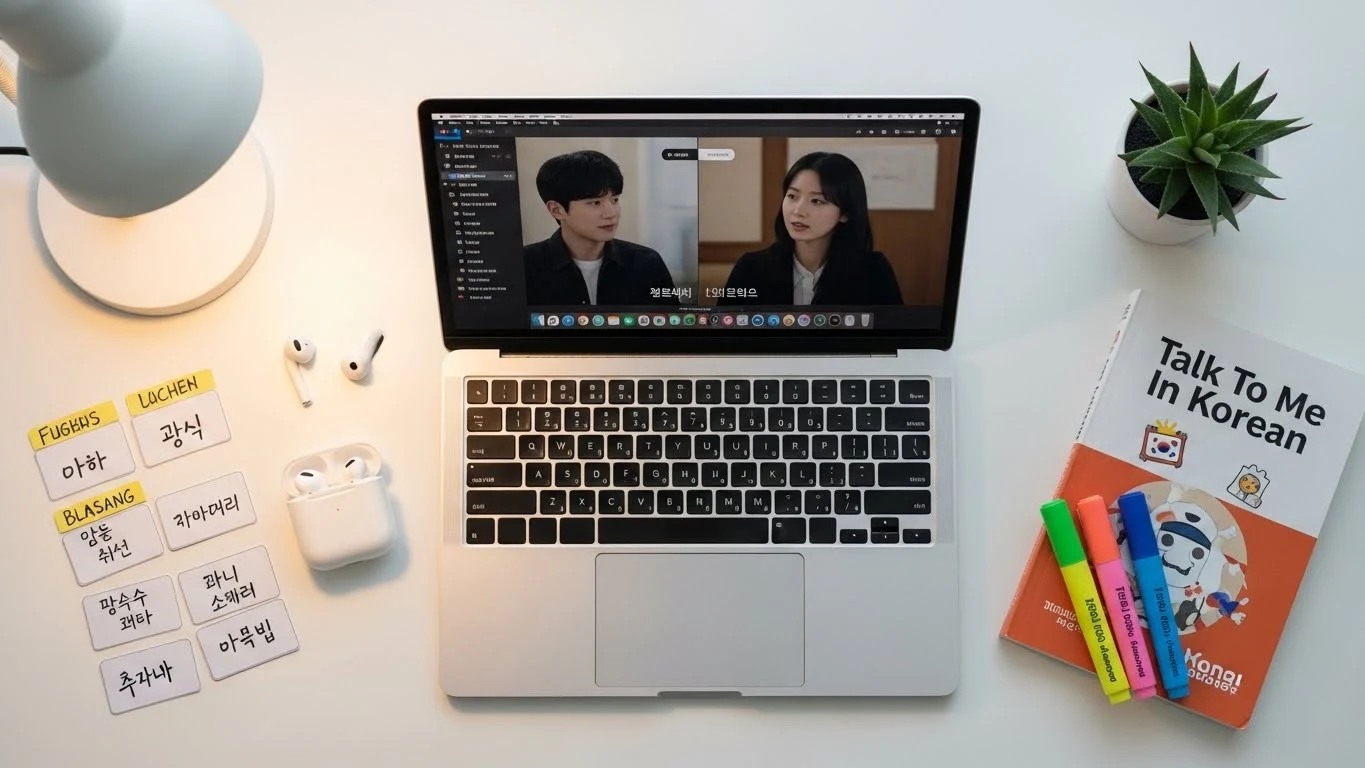
1. Dual Subtitle Strategy: First viewing with English subtitles to understand content, second viewing with Korean subtitles. Third attempt without subtitles. Netflix and Viki offer multiple subtitle options, and in 2026, browser extensions like Sabi now enable side-by-side dual subtitle viewing with hover-to-translate word lookup.
2. Short Scene Repetition: Select a 15–20 minute scene and watch 5–10 times. Research shows immersive repetition significantly improves retention compared to passive watching.
3. Shadowing: Repeat actors’ lines 0.5 seconds behind. This method effectively improves both pronunciation and intonation simultaneously.
4. AI-Powered Conversation Practice (2026 Trend): Tools like Duolingo’s upgraded Korean course, AI conversation tutors (such as Langua and Speak), and even ChatGPT-based roleplay now let you practice dialogue from drama scenes with real-time feedback on pronunciation and grammar. The King Sejong Institute Foundation also launched an AI Tutor in 2026 for conversation-based learning.
5. Genre-Based Learning Strategy: Romance dramas like ‘Can This Love Be Translated?’ (everyday emotional vocabulary), workplace dramas like ‘See You at Work Tomorrow’ (business Korean), slice-of-life dramas like ‘Yumi’s Cells’ (daily conversational patterns), and historical dramas like ‘Perfect Crown’ (formal expressions) enable progressive learning tailored to your goals.
7. Frequently Asked Questions (FAQ)
Q1. How long does it take to learn Korean with K-drama watching?
A1. With 1 hour daily of drama watching and active review, basic conversation becomes possible within 3–6 months. Combining K-drama immersion with AI conversation tools — a popular approach in 2026 — can accelerate progress by roughly 30% compared to passive watching alone.
Q2. Which drama genres work best for beginners?
A2. Romantic comedies and daily life dramas are most suitable. Classic favorites like ‘Crash Landing on You’ and ‘What’s Wrong with Secretary Kim’ remain excellent starting points. For 2026 picks, ‘Can This Love Be Translated?’ features clear multilingual dialogue, and ‘Yumi’s Cells’ Season 3 uses straightforward everyday language — both ideal for beginners.
Q3. Are Korean or English subtitles more effective?
A3. A phased approach works best: initially focus on content comprehension with English subtitles, then switch to Korean subtitles once comfortable. In 2026, dual-subtitle browser extensions like Sabi allow you to display both simultaneously — training listening and reading at the same time.
Q4. Does drama Korean differ from real Korean?
A4. Modern contemporary dramas reflect over 90% of actual Korean. However, historical or fantasy dramas contain archaic language or special expressions unsuitable for beginners.
Q5. What are the best free tools to supplement K-drama learning in 2026?
A5. Netflix and Viki provide Korean subtitles for most K-dramas. Duolingo’s revamped Korean course (July 2026) now covers up to B2 level. Talk To Me In Korean offers free grammar lessons, and the King Sejong Institute’s new AI Tutor provides free conversation practice tailored to individual learner goals.
8. Related Reading
1) Korean Language Exchange Complete Guide – Boost Confidence with 10-Minute Conversation Parties
2) 100% K-Drama Utilization Method for Korean Learners: Roadmap to Watching Without Subtitles
3) Korean Learning App Comparison: Duolingo vs Talk To Me In Korean – 15 Million Download Battle Winner
9. References
1) Korean Language Learning Market Size, Outlook 2025-2034 (GM Insights, 2025)
Korean language learning market valued at $7.2 billion in 2024, estimated at $8.9 billion in 2026, and projected to reach $67 billion by 2034 at 25.1% annual growth rate.
2) Enrollment in Korean classes has shot up thanks to cultural imports (NPR, 2022)
U.S. college Korean language enrollment increased 78% from 2009 to 2021, driven by K-pop and K-drama cultural influence.
3) 2025 Duolingo Language Report (Duolingo, 2025)
Korean climbed to the 6th most-studied language globally on Duolingo in 2025, surpassing Italian, with courses now available to speakers of 27+ languages.
4) A snapshot of Korean language now (The Korea Herald, 2024)
Approximately 82 million people worldwide speak Korean, ranking among the top 15 languages globally by total speakers.
5) 10 K-dramas to learn Korean with (EF GO Blog, 2025)
Analysis of effective Korean learning strategies and recommended drama titles for language learners.
6) Our Updated Korean Course Has Brand-New Content and Features (Duolingo Blog, July 2026)
Major Korean course overhaul with B1/B2 content, expanded to 27+ source languages, serving 1.9 million active learners worldwide.
Recommended Video Resources
📺 YouTube Channels:
• Talk To Me In Korean – https://www.youtube.com/@TalkToMeInKorean (K-drama dialogue analysis)
• Korean Unnie – https://www.youtube.com/@KoreanUnnie (Drama expression explanations)
• Learn Korean with KoreanClass101 – https://www.youtube.com/@KoreanClass101 (Scene-based conversation learning)
🎵 TikTok Learning Content:
• #learnkoreanwithkdrama – Expression learning through short K-drama clips
• #koreanlanguagelearning – Native speaker pronunciation practice videos
• #kdramamoments – Popular dialogue repetition challenges