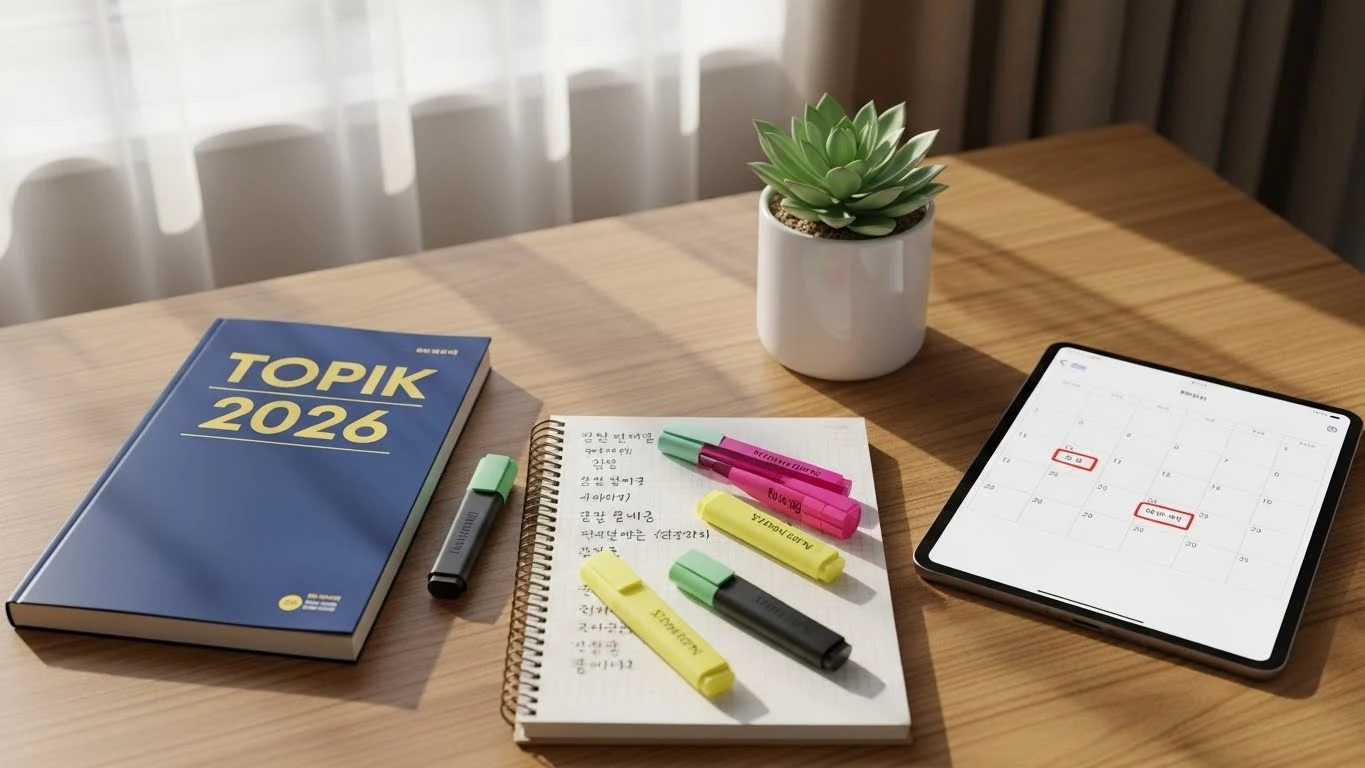
Updated August 4, 2026: Nine of this year’s fifteen exams are already finished. Six remain, and the rest of the 2026 TOPIK schedule now hinges on two registration windows: the 108th PBT opens today (August 4–10 in Korea), and the 15th IBT plus the year’s final Speaking test open August 18–24.
1. 2026 TOPIK Schedule: What Is Left This Year
Before reading the 2026 TOPIK schedule, one line of context: TOPIK (Test of Proficiency in Korean) certifies Korean ability for non-native speakers and overseas Koreans. It is administered by the National Institute for International Education (NIIED) under Korea’s Ministry of Education, and now runs in 368 locations across 89 countries.
The full 2026 TOPIK schedule covers fifteen exams: six paper-based (PBT), six computer-based (IBT), and three Speaking tests. Nine are done. Here is the honest picture if you are still planning a 2026 attempt — six chances remain, and one registration window has already shut.
1. Still open or opening: 108th PBT (August 4–10), 15th IBT and 12th Speaking (August 18–24), 16th IBT (September 15–21), 109th PBT (September 1–7)
2. Already closed: 14th IBT (registration ended July 13; the exam itself runs September 12)
3. Demand keeps climbing — applicants rose from roughly 360,000 in 2022 to about 550,000 by September 2025, and popular Korean centers fill within hours
One structural change defines the 2026 TOPIK schedule: IBT expanded from 13 countries to 17, adding India, Nepal, Laos, and Bahrain. If IBT was not an option where you live, it may be now. Speaking, by contrast, is still administered only inside Korea.
2. Remaining PBT Sessions (108th and 109th)
PBT is the traditional pencil-and-paper format, and it remains the most widely available option worldwide. Two sessions are left on the 2026 TOPIK schedule. The 108th is the one to act on right now — registration in Korea opened today and closes August 10.
| Session | Registration | Test Date (Korea) | Overseas | Results |
|---|---|---|---|---|
| 108 | Aug 4-10, 2026 | Oct 18 (Sun), 2026 | Oct 17-18 | Dec 10, 2026 |
| 109 | Sep 1-7, 2026 | Nov 15 (Sun), 2026 | Nov 15 | Dec 22, 2026 |
Two warnings. Domestic registration for the 108th is staggered by region across the opening days, so check which day covers your province before you log in. And overseas periods are set by each country’s administering body, often diverging from the Korean TOPIK schedule entirely — Germany’s 108th window closed in July, as did the UK’s. Contact your local Korean embassy, Korean Education Center, or King Sejong Institute instead of assuming Korean dates apply.
3. Remaining IBT Sessions (14th, 15th, 16th)
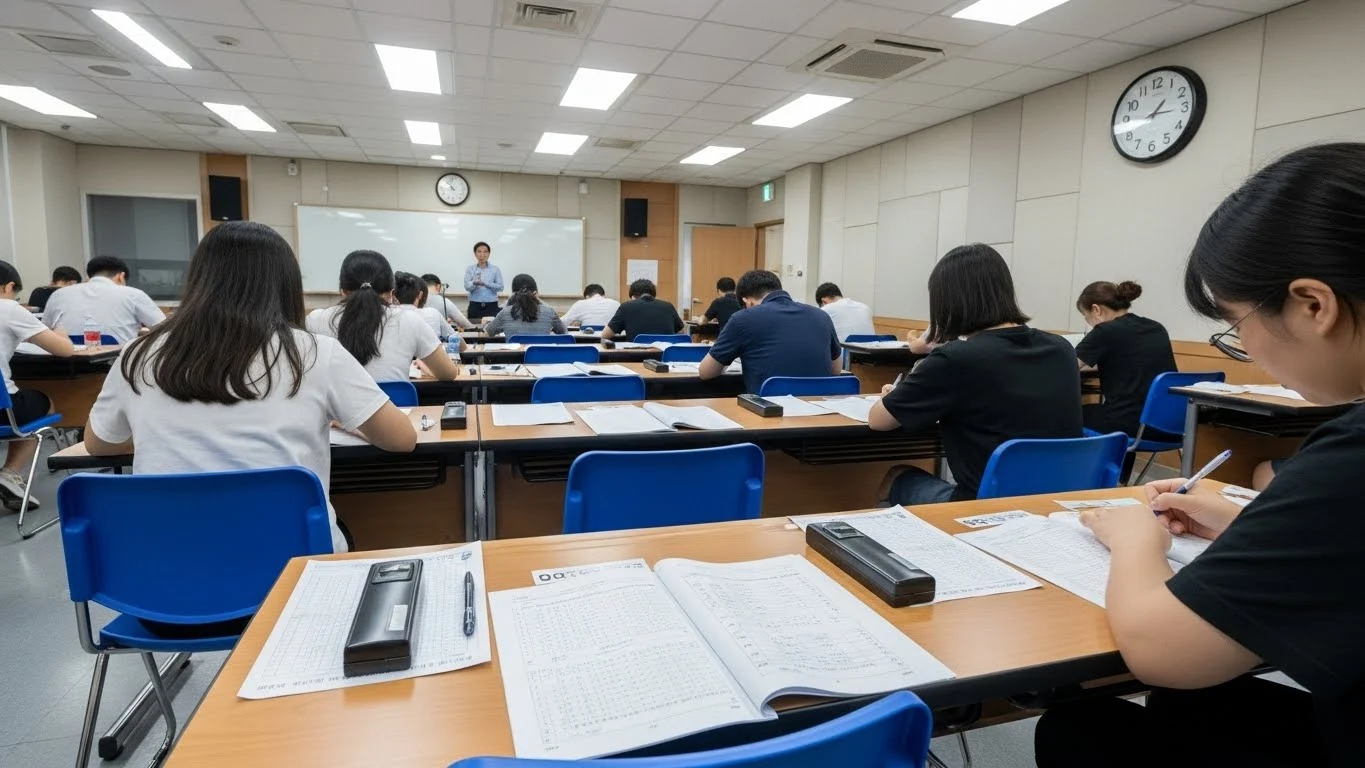
Three IBT sessions close out the 2026 TOPIK schedule. IBT launched in 2023 as the computer-based alternative. Questions appear on screen, answers go in by mouse and keyboard, and the TOPIK II essay is typed rather than handwritten. Its biggest advantage is speed: results land in about three weeks instead of the seven or eight that PBT takes.
| Session | Registration | Test Date | Results |
|---|---|---|---|
| 14 | Closed (Jul 7-13) | Sep 12 (Sat), 2026 | Oct 2, 2026 |
| 15 | Aug 18-24, 2026 | Oct 24 (Sat), 2026 | Nov 13, 2026 |
| 16 | Sep 15-21, 2026 | Nov 28 (Sat), 2026 | Dec 18, 2026 |
That speed gap matters. For a Spring 2027 university intake or a year-end visa filing, the 15th IBT on October 24 posts results on November 13 — nearly a month before the 108th PBT results on December 10, despite the two exams sitting a week apart. Working backward from your paperwork deadline is the most useful thing you can do with the 2026 TOPIK schedule.
One caveat: Korean typing speed becomes a real variable in the TOPIK II writing section. If you have never typed Hangul under time pressure, practice before committing to IBT.
4. The Final Speaking Test of the Year
TOPIK Speaking is a separate 30-minute, computer-based assessment covering six tasks, scored out of 200 across six levels. Only one session remains on the 2026 TOPIK schedule, and it shares a registration window with the 15th IBT.
Session 12: Registration August 18–24, 2026 → Test October 24 (Sat) → Results November 16, 2026
Two things to know before you pay. Speaking runs only in Korea, so overseas learners cannot sit it locally. And as of 2026 it does not count toward F-2-7 residency points — that table still recognizes only TOPIK II written levels. Speaking carries real weight in university interviews and employer screening, but it is not a visa shortcut.
The most effective preparation is not more textbook study but structured talking practice. Our guide to Korean language exchange meetups covers how to build that habit in short, repeatable sessions.

5. Fees, ID Rules, and What to Bring
Despite ongoing discussion about digitizing the exam, fees attached to the 2026 TOPIK schedule have not moved inside Korea. Overseas rates are set locally and vary widely — German centers charge in euros, for example, at rates that do not track the Korean figures.
| Test Format | TOPIK I | TOPIK II |
|---|---|---|
| PBT (Paper) | ₩40,000 (~$29) | ₩55,000 (~$40) |
| IBT (Computer) | ₩70,000 (~$51) | ₩95,000 (~$69) |
| Speaking | ₩80,000 (~$58) | |
The rule that trips up international candidates most often has nothing to do with Korean ability: the full English name you type during registration must match your photo ID exactly. A missing middle name, a transposed letter, or an omitted hyphen can get you turned away at the door. Check it character by character before you submit, and again when your admission ticket is issued.
1. Required for every format: original government-issued photo ID (passport or alien registration card) plus your printed admission ticket
2. PBT only: a computer marking pen is provided at most centers, but bring correction tape
3. IBT and Speaking: nothing needed — equipment is supplied, and personal devices are collected before entry
6. What Changed in 2026: New Rules and Scam Warnings
NIIED tightened several policies alongside the 2026 TOPIK schedule, and a few are worth reading carefully before you register.
1. AI devices are explicitly banned. Any device with AI translation or writing functions is barred from the exam room, smart glasses included. Cheating brings disqualification plus a suspension of up to two years from the TOPIK schedule.
2. Automated registration is being cancelled. The TOPIK center warns that registrations judged to have used macro programs will be voided and the accounts suspended. Log in and register manually.
3. Watch for registration scams. NIIED has issued a standing warning about social media ads offering proxy test-taking, leaked questions, paid registration agents, or guaranteed passes. These are illegal, questions are held under strict security, and people who buy in lose both their money and their eligibility.
4. Priority registration expanded. Inside Korea, priority access now covers people with disabilities, pregnant candidates, and those with mobility difficulties.
5. The exam is professionalizing. NIIED is phasing in a question bank system and researching how to align scoring standards across PBT and IBT. For test-takers, that mostly means fewer difficulty swings between sessions.
7. Why Your TOPIK Level Matters More Than Ever
A score is not just a certificate, which is why the TOPIK schedule fills up so fast. In 2026 a level functions as a gatekeeper across three separate systems, and the thresholds are more consequential than most first-time candidates realize.
University admission. Korean-taught degree programs typically require Level 3, with selective departments asking for Level 4. English-taught programs substitute IELTS or TOEFL, though a Korean score still strengthens an application. Korea also tightened institutional oversight this year, so confirm your target university currently holds visa-issuing authority.
Part-time work permission. This is where the threshold bites hardest. Students on D-2 and D-4 visas need immigration permission to work at all, and Level 3 unlocks meaningful weekly hours. Below it, the allowance is minimal or nonexistent depending on visa type.
Employment and residency. Many Korean employers set Level 4, 5, or 6 as a hard filter, and TOPIK II levels carry weight in the F-2-7 points system. Scores stay valid two years from the announcement date, so timing your attempt against the 2026 TOPIK schedule matters as much as passing.
Still deciding which level to target? Our complete TOPIK preparation guide breaks down the difficulty gap between TOPIK I and TOPIK II and the realistic pass rates at each band.
8. Study Plan for the October and November Exams
With the remaining dates on the 2026 TOPIK schedule eight to sixteen weeks out, generic advice is less useful than a calendar. Here is how to spend the time you actually have.
1. Weeks 1–2: diagnose, then choose your level. Sit one full past paper under timed conditions before studying anything. Candidates routinely register for TOPIK II when a Level 2 pass would meet their actual requirement, and the two exams reward very different preparation.
2. Weeks 3–8: vocabulary and listening, daily. TOPIK I draws on roughly 1,500–2,000 words; TOPIK II demands 3,500–4,000. Twenty to thirty new words a day through spaced repetition is the reliable path. Pair it with listening at natural speed — our roundup of essential K-drama expressions is a good on-ramp when textbook audio feels lifeless.
3. Weeks 6–10: writing, for TOPIK II only. Question 54 asks for roughly 700 characters of argumentative writing and carries 50 points alone. Two essays a week with feedback beats ten written into a void. On a budget, the government-run King Sejong Institute offers free structured writing practice.
4. Final 3 weeks: simulate. Sit full papers at the real exam start time. TOPIK II runs 180 minutes across two sessions, and the common failure mode is not vocabulary but running out of time in reading.
5. IBT candidates only: practice typing. Ten minutes of Hangul typing daily for a month is enough to stop the keyboard from costing you points.

9. Looking Ahead to 2027
The 2027 TOPIK schedule has not been published yet. The Ministry of Education released the 2026 plan on October 10, 2025, and the prior year followed the same rhythm, so expect the 2027 announcement around October with the first registration window opening in December.
Two trends should carry forward. IBT capacity has grown every year since 2023, in both Korean centers and participating countries, so more learners will get a computer-based option closer to home. And the direction of travel is digital — paper testing remains fully available at unchanged fees, but NIIED’s investment is flowing toward the internet-based format.
If your target is a 2027 intake, there is still a case for using the 2026 TOPIK schedule this autumn. Scores stay valid two years, a real attempt exposes weak areas better than any mock test, and you will know exactly what you are walking into.
10. Frequently Asked Questions (FAQ)
Q1. What is the next TOPIK exam I can still register for?
A1. On the 2026 TOPIK schedule it is the 108th PBT — registration in Korea runs August 4–10 for an October 18 exam. Miss it and the 15th IBT and 12th Speaking open August 18–24, followed by the 109th PBT on September 1–7. Overseas deadlines differ by country and several have passed.
Q2. Which remaining exam gets me results fastest?
A2. The 15th IBT on October 24 posts results on November 13 — the earliest date available from any registration window still open on the TOPIK schedule, which makes it the practical choice for a year-end application deadline.
Q3. Is paper-based TOPIK being discontinued?
A3. Not this year. All six PBT sessions on the 2026 TOPIK schedule are running as planned at unchanged fees, and PBT remains the only format available in many countries. Long term, NIIED continues to expand IBT capacity, so learners with a choice may want to get comfortable with the computer-based format.
Q4. How do I register from outside Korea?
A4. Registration abroad runs through each country’s designated administering body, and the local TOPIK schedule may differ from Korea’s. Contact your nearest Korean embassy, Korean Education Center, or King Sejong Institute. Methods vary — some countries use online forms, others take email applications or walk-ins only.
Q5. What score do I need for each level?
A5. TOPIK I: Level 1 needs 80+ points, Level 2 needs 140+. TOPIK II: Level 3 needs 120+, Level 4 needs 150+, Level 5 needs 190+, Level 6 needs 230+. Level 3 is the threshold that unlocks most practical benefits, including student part-time work permission.
11. Related Reading
1) TOPIK Test Preparation: Strategy Guide for Every Level
2) How to Learn Korean with K-Dramas: Your Roadmap to Watching Without Subtitles
3) Complete Guide to Language Exchange for Korean Learning
12. References
1) TOPIK Official Website (NIIED) — registration, notices, and results
https://www.topik.go.kr/
2) Ministry of Education Announces 2026 TOPIK Implementation Plan — Korea Study News
https://www.studykoreanews.com/news/articleView.html?idxno=1761
3) TOPIK Exam Schedule 2026 with country-by-country registration contacts — TOPIK Easy6
https://topikeasy6.com/news/topik-exam-schedule
4) TOPIK Test Schedule in Year 2026 — TOPIK GUIDE
https://www.topikguide.com/topik-test-schedule/
5) TOPIK 2026 Schedule: Test Dates, Registration and Results — Korean Topik
https://www.koreantopik.com/2025/11/topik-2026-schedule-complete-test-dates.html
13. Additional Resources (Courses and Video)
1) Talk To Me In Korean YouTube Channel — grammar, pronunciation, and TOPIK prep
https://www.youtube.com/@talktomeinkorean
2) Talk To Me In Korean Course Curriculum — includes a dedicated TOPIK preparation track
https://courses.talktomeinkorean.com/course-curriculum-preview-by-topic
3) National Institute for International Education (NIIED) Official Website
https://www.niied.go.kr/