
Bottom line: Seoul aesthetic cafes have grown past the pure photo-op era. In 2026 the city’s coffee scene runs on one industry keyword — B.E.Y.O.N.D — and the best rooms in Seongsu-dong, Ikseon-dong and Yeonnam-dong now sell wellness menus, local sourcing and quiet time as hard as they sell a backdrop.
1. What Changed for Seoul Aesthetic Cafes in 2026
Seoul aesthetic cafes are no longer competing on interiors alone. Walk into Seongsu-dong on a Saturday and you’ll still find queues wrapped around pink-clad pop-up buildings, but the rooms that hold their crowds through a slow Tuesday are doing something else — and the industry has a name for it.
At the 24th Seoul International Café Show, organisers named B.E.Y.O.N.D the coffee trend keyword for 2026, framing the cafe as a platform where people, brands, place and technology resonate together rather than a room that simply sells espresso. It’s a useful lens for visitors, because each letter maps onto something you can actually taste, book or photograph.
1. Better Community — cafes acting as neighbourhood hubs, hosting workshops, listening sessions and brand collaborations rather than just seating
2. Everyday Wellness — decaf, plant-based milks and low-stimulant drinks moving from a niche request to a default menu column, alongside natural-material interiors
3. Your Moment — mood-matched menus, curated playlists and lighting designed around how you want the hour to feel
4. Original Local — Korean-grown fruit, regional grains and farm partnerships used as brand identity, not just as sourcing
5. Nature Forward — smaller portions, plainer packaging, reusable cups and refill stations as a baseline expectation
6. Digital Touch — AI recommendations and robot baristas tuned for warmth rather than novelty, which is a genuine shift from the gimmick machines of 2023
The other change is competition. Korea’s cafe market has moved out of its boom phase and into consolidation, which sounds grim but has been good for visitors: the rooms that survive are the ones with an actual point of view. If you visited Seoul in 2022 and found every third cafe interchangeable, 2026 reads differently.
Timing tip: The 25th Seoul International Café Show runs 11–14 November 2026 at Coex in Gangnam, with public days on 13–14 November. If your trip overlaps, it pairs neatly with a Seongsu-dong afternoon — both sit on Subway Line 2.
2. Seongsu-dong: Factory Lofts, Pop-Ups and Robot Baristas
Seongsu-dong (성수동) earned the “Brooklyn of Seoul” tag honestly. From the late 1950s this was a working district of shoe, printing and steel factories; when manufacturing collapsed, young designers moved into the cheap, high-ceilinged shells and never left. Today it’s the densest concentration of Seoul aesthetic cafes anywhere in the city, and the neighbourhood the rest of Korea watches for what’s next.
1. Daelim Changgo (대림창고) — the warehouse that started it all. Vaulted ceilings, exposed iron columns, raw brick, and a gallery hung across the middle of the room. Roasting happens on site. Open daily 11:00–22:00; expect a premium on the coffee and forgive it for the room.
2. Cafe Onion Seongsu (어니언 성수) — a 1970s building stripped back rather than renovated, opened in 2016 and still the reference point for the whole “unfinished concrete” school. The bakery is the real draw: the salt bread and seasonal croissants sell out. Opens 08:00 on weekdays, 09:00 weekends — the earliest useful start in the district.
3. A to B (에이투비) — a small upstairs cafe-bar under the elevated railway arches near Seongsu Station, running 12:00–23:00. Espresso in the afternoon, cocktails after dark, and a coldbrew tiramisu worth the detour.
4. Lowkey — a quieter, specialty-first counter inside the Hey Ground building, open 09:00–18:00. Choose your beans, order bean-to-bar chocolate alongside, and watch the local startup crowd work. Good when Seongsu’s main strip is unbearable.
5. LoungeX Seongsu — the Digital Touch pillar made literal: a 24-hour robot-barista cafe in the Seongsu CF Tower with power outlets, a reading annex and genuinely decent coffee. Useful for jet lag and late arrivals.
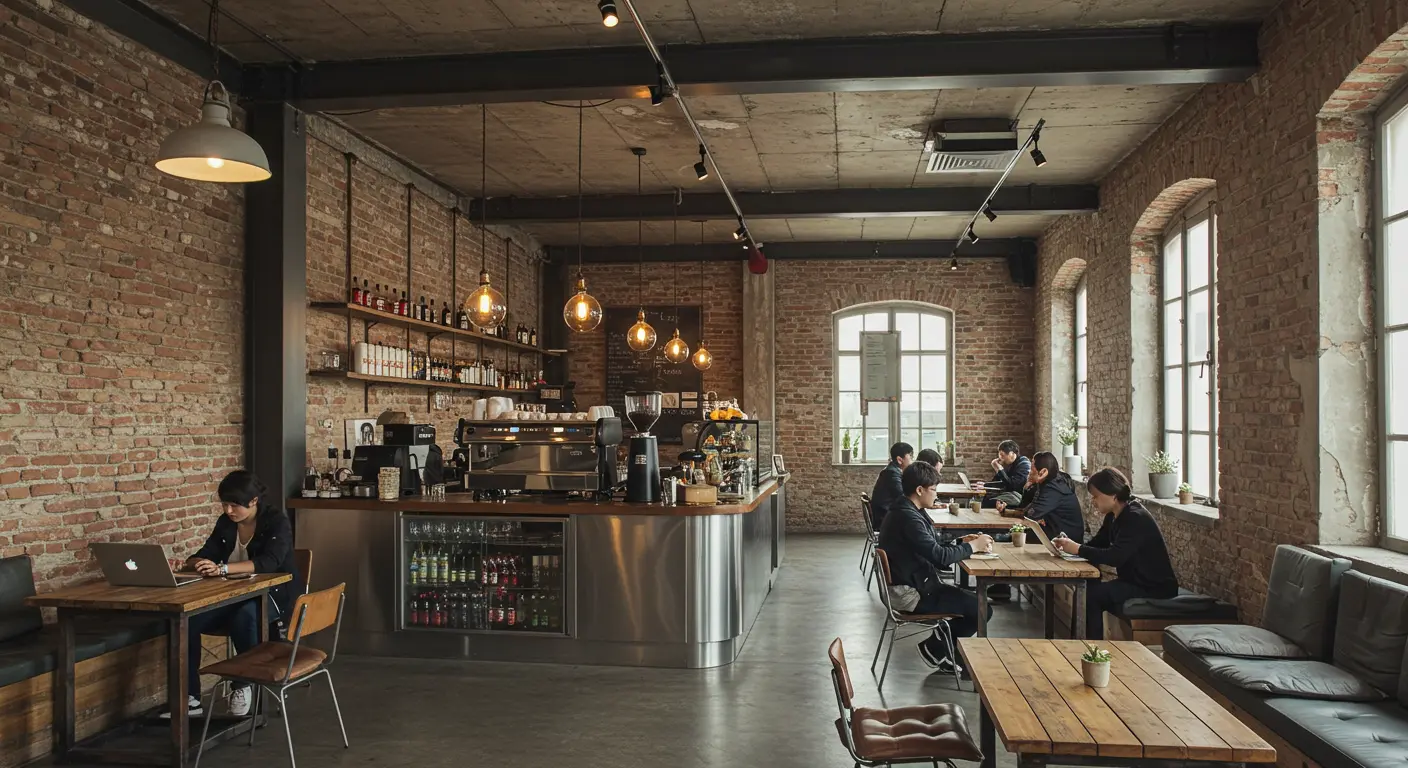
Two non-cafe stops anchor a Seongsu afternoon in 2026. Glow Seongsu has been reworked from a showroom into a rotating culinary curation space — a Seongsu-flavoured food hall with seasonal tenants, a pond, and candles floated across it after dark. And Olive Young N Seongsu, the 46,000-square-foot beauty flagship on Yeonmujang 7-gil, has become the district’s biggest single draw, with free four-cut photos for the first 300 visitors daily and a cafe stand that changes its collaboration menu monthly.
Seongsu-dong price guide (2026): Americano 5,000–7,000 KRW | Signature drinks 7,500–9,500 KRW | Bakery 5,000–8,500 KRW | Dessert plates 8,000–12,000 KRW. Specialty single-origin pour-overs run higher, often 12,000–20,000 KRW.
3. Ikseon-dong: 1920s Hanok Alleys, Reimagined
Ikseon-dong (익선동) is Seoul’s oldest planned hanok neighbourhood, laid out in the early 1920s and preserved as a grid of alleys barely wide enough for two people. The whole quarter runs about 800 metres, connecting Insa-dong to Nakwon Sanga, and it packs more than fifty independent cafes, bars and dessert rooms into that stretch.
What makes it work is that no single developer designed it. Each hanok was reinterpreted by whoever took the lease, so the newtro aesthetic here — new plus retro — feels accumulated rather than art-directed. Where Seongsu-dong presents one coherent industrial identity, Ikseon-dong is dozens of small decisions stacked on top of each other.
1. Seoul Coffee (서울커피) — the district’s best-known hanok cafe, with semi-outdoor courtyard seating, handmade cube ice cream and an injeolmi bingsu that regularly sells out. Open daily 11:00–22:00. The seating area is small; expect a short queue.
2. Cheongsudang Bakery (청수당) — reached across stepping stones over shallow ponds, with bamboo screening the entrance. Order the soufflé castella with honey and nuts. Open 10:30–20:00 daily, and a queue forms roughly fifteen minutes before opening.
3. Nakwon (낙원) — a railway-themed room where model trains carry the dessert display around the counter. The name means “paradise,” and the peanut cream latte and matcha cheesecake justify it. Open 11:00–22:00.
4. Midamheon (미담헌) — a century-old hanok serving premium leaf teas at traditional low seating, with an open courtyard that turns beautiful in rain. The most contemplative room in the neighbourhood, and the one to choose when the alleys get loud.
Cultural note: Many Ikseon-dong hanok cafes retain some form of the traditional ondol underfloor heating system, which is why the neighbourhood is at its best from December to February — you sit on a warm floor while snow settles on the tiled roofs a metre above your head.
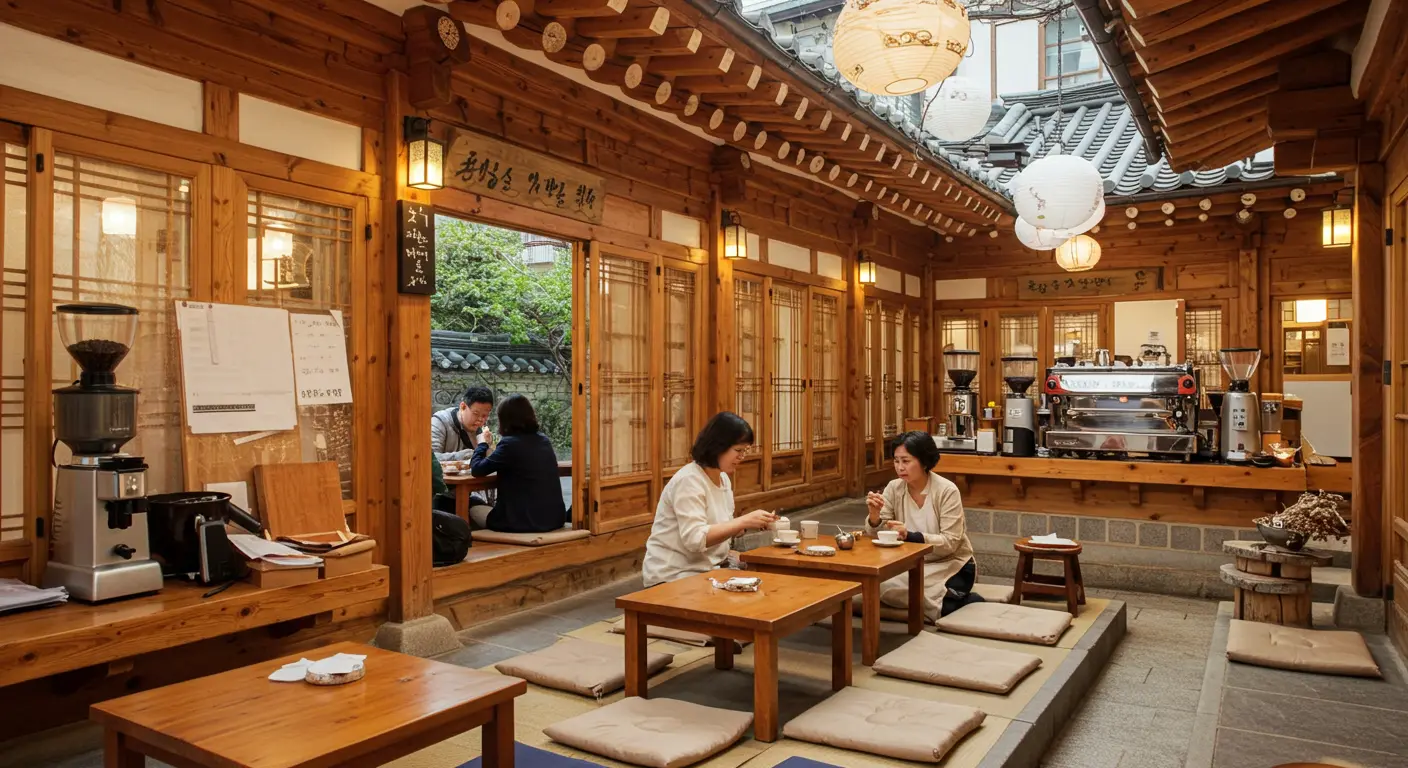
One practical advantage worth knowing: Ikseon-dong’s social-media saturation still sits below Seongsu’s. You can walk in without research and discover a room yourself, which is increasingly rare. Friday evenings are the one reliably congested window; weekday mornings are close to empty.
4. Yeonnam-dong: Brunch, Roasteries and Slow Mornings
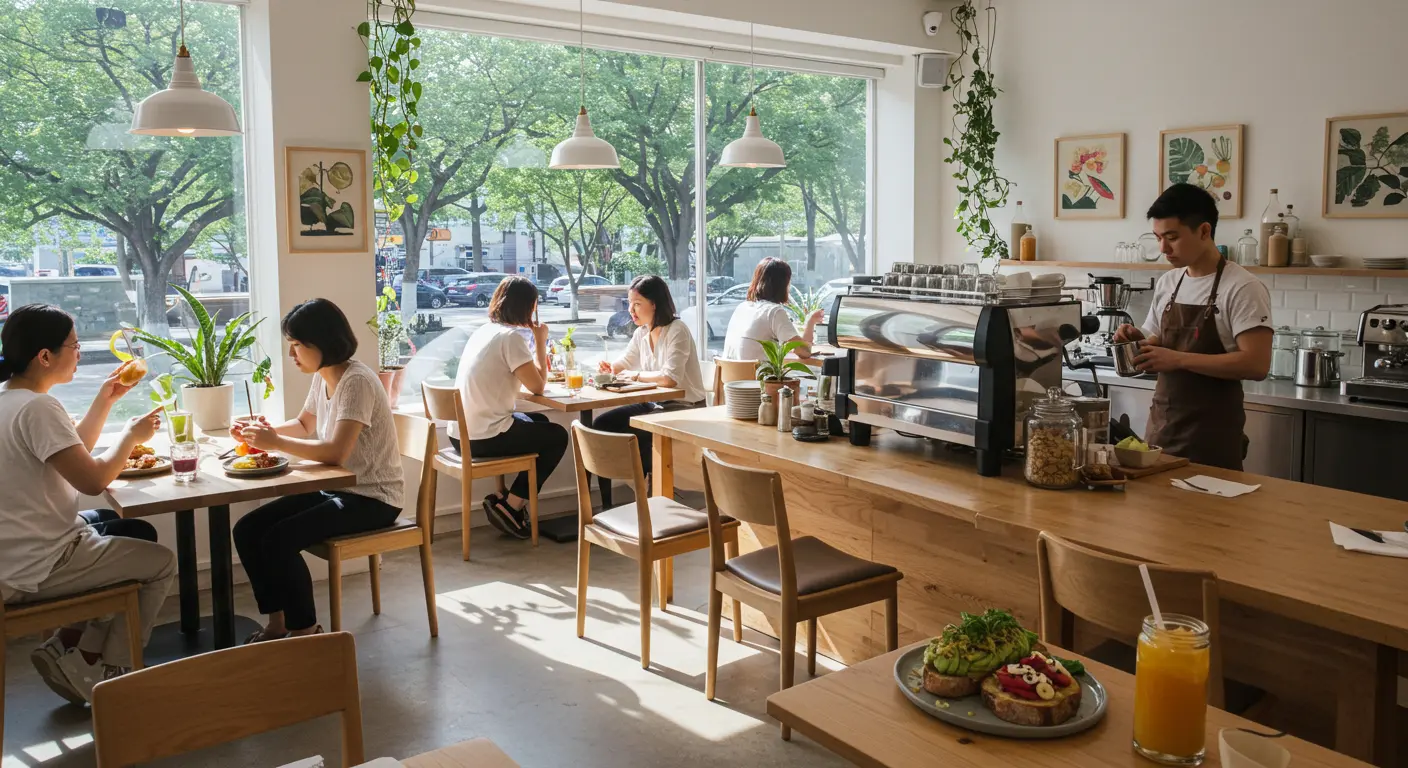
Yeonnam-dong (연남동) sits along the Gyeongui Line Forest Park, a converted railway corridor locals call Yeontral Park. It’s residential in a way the other two districts aren’t, and the cafe culture reflects that: all-day brunch, serious roasting, and rooms designed for staying rather than photographing.
1. Tailor Coffee (테일러커피) — a composed, gallery-like space that lets the coffee lead. The einspänner is the house benchmark and the pour-over is excellent. Open daily 10:00–22:00. Note the spelling: it’s Tailor, not Taylor.
2. Cafe JAMJAM (잼잼) — a basement brunch room on Seongmisan-ro that opens up far larger than the street frontage suggests. Black sesame cream latte, in-house croissants baked through the day, and photo corners tucked into the back. Open 10:00–21:00, until 22:00 on weekends.
3. Grain Seoul — consistently the highest-rated brunch table in the area, with sourdough, build-your-own plates and reliable gluten-free handling. Open 09:00–16:00 and closed Tuesdays, which catches out a lot of visitors.
4. Coffee Libre (커피리브레) — one of Korea’s foundational specialty roasters, with an unassuming Yeonnam branch behind the main street. Buy beans, get an espresso on the house, and take the upstairs seating. Open 11:30–20:00.
5. identity coffeelab (아이덴티티커피랩) — a precise, steel-and-concrete counter on Donggyo-ro built entirely around extraction. Two bean choices per drink and a printed tasting note on the cup holder. Open 11:00–19:30, closed Sundays.
5. Planning a Seoul Aesthetic Cafes Crawl: Prices and Etiquette
Three or four stops is the realistic ceiling for one day. Any more and the coffee stops registering. The table below is the honest comparison most guides skip.
| District | Best for | Nearest station | Avg. spend | Quiet window |
|---|---|---|---|---|
| Seongsu-dong | Industrial rooms, pop-ups, late hours | Seongsu (Line 2), Exit 3 or 4 | 18,000–25,000 KRW | Weekdays 08:00–11:00 |
| Ikseon-dong | Hanok courtyards, desserts, walkability | Jongno 3-ga (Lines 1/3/5), Exit 4 | 15,000–20,000 KRW | Weekdays 11:00–13:00 |
| Yeonnam-dong | Brunch, specialty roasting, staying put | Hongik Univ. (Lines 2/AREX), Exit 3 | 20,000–35,000 KRW | Weekdays 10:00–12:00 |
Etiquette that actually matters in 2026:
1. Check the seating clock. Small hanok and brunch rooms increasingly post 90-minute or two-hour limits at peak times. It’s on the table card, not the door.
2. Order per person. Sharing one drink across three seats is the one thing that reliably annoys staff, especially in rooms with twenty covers.
3. Ask before photographing people. Interiors are fine. Other customers are not, and Korean privacy norms around this tightened noticeably after 2024.
4. Bring a cup if you can. Reusable-cup discounts of 300–500 KRW are now standard, and refill stations have spread well beyond flagship stores.
5. Expect card-only. A growing share of independent cafes hold no cash at all. Foreign Visa and Mastercard work almost everywhere; contactless is standard.
Getting between districts: Seongsu and Hongik University both sit on Line 2, so Seongsu-dong and Yeonnam-dong connect directly in about 25 minutes. Ikseon-dong needs one transfer. Our Korean public transportation guide for 2026 covers the Climate Card, T-money and WOWPASS options in full.
6. Photography Tips That Still Work in 2026
The rooms are designed for a camera, so the difficulty isn’t getting a usable shot — it’s getting one that doesn’t look like the other four hundred thousand.
1. Shoot the light, not the room. Between 14:00 and 16:00, Seongsu’s tall factory windows throw hard directional light across concrete. That contrast is the shot; a flat evenly-lit frame isn’t.
2. Use architecture as a frame. Exposed beams, brick arches and hanok door frames all give you a natural border. Standing back and shooting through something beats standing close.
3. Go tighter than feels natural. Latte art, a cup on a wood grain, steam against a dark wall — detail shots hold up far longer than wide interiors, and they don’t put strangers in your frame.
4. Match your palette to the room. Seongsu runs grey and rust; Ikseon runs warm timber and paper; Yeonnam runs white and pale wood. Dressing to the neighbourhood is the single easiest upgrade.
5. Skip the flash. Every one of these rooms is lit deliberately. Flash flattens the whole point of the space and marks you out instantly.
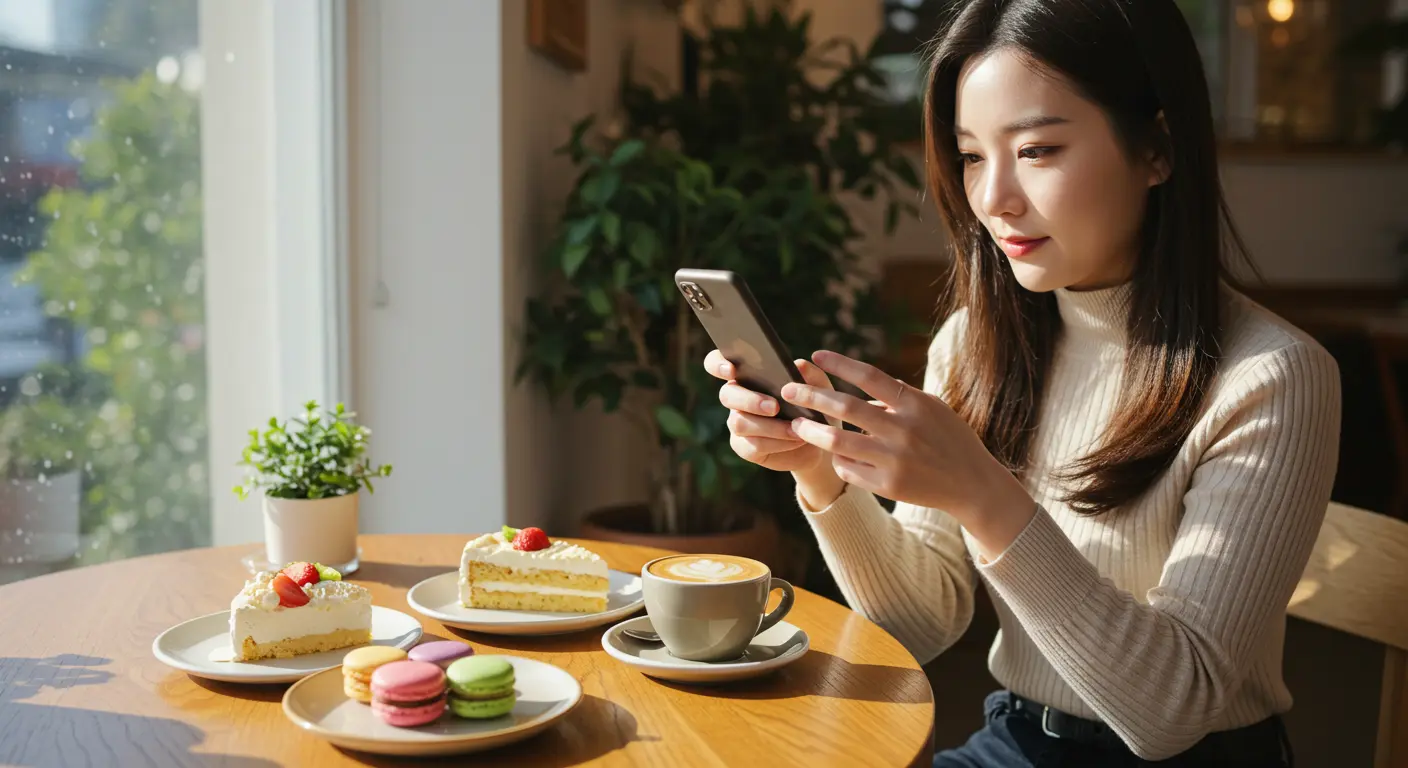
Gear note: A phone is genuinely enough. Daylight in these rooms is strong and the surfaces are neutral, which is exactly the condition phone computational photography handles best. Save the effort for choosing your seat.
7. Frequently Asked Questions (FAQ)
Q1. When is the best time to visit without queuing?
A1. Weekday mornings between 10:00 and 11:30 are the quietest window across all three neighbourhoods, and the light is excellent. Friday evenings and weekend afternoons are the busiest. Several Seongsu cafes now open at 08:00, so an early start beats the pop-up crowds entirely.
Q2. How much does a cafe-hopping day cost in 2026?
A2. Budget roughly 35,000–60,000 KRW per person for three or four stops. A standard americano runs 5,000–7,000 KRW, signature drinks 7,500–9,500 KRW, and dessert 7,000–11,000 KRW. Brunch plates in Yeonnam-dong typically land between 15,000 and 25,000 KRW.
Q3. Do Seoul cafes accept foreign cards and cash?
A3. Most cafes in these districts take Visa and Mastercard, and many are now card-only with no cash drawer at all. Contactless works widely. Carrying a WOWPASS or a topped-up transit card as a backup is still worth it for smaller independent rooms.
Q4. Can you order in English?
A4. Yes, in practice. Cafes in Seongsu, Ikseon and Yeonnam almost all keep English or photo menus, and staff handle basic English orders comfortably. Tablet and QR ordering with an English toggle has become common since 2025.
Q5. Is it acceptable to work on a laptop?
A5. It depends on the room. Larger Seongsu warehouse cafes and 24-hour spaces welcome laptops. Small hanok cafes in Ikseon-dong and weekend brunch rooms in Yeonnam-dong often post a 90-minute or two-hour limit during peak periods. Check the table card before settling in.
Q6. Which neighbourhood should a first-timer choose?
A6. Pick Seongsu-dong for industrial architecture and pop-ups, Ikseon-dong for hanok courtyards and a compact alley grid, and Yeonnam-dong for brunch and specialty roasting. Seongsu and Yeonnam share Line 2, so they pair easily in one day.
8. Related Reading
9. Sources and References
Neighbourhood details, opening hours and pricing in this guide were verified in August 2026 against official tourism sources and current business listings.