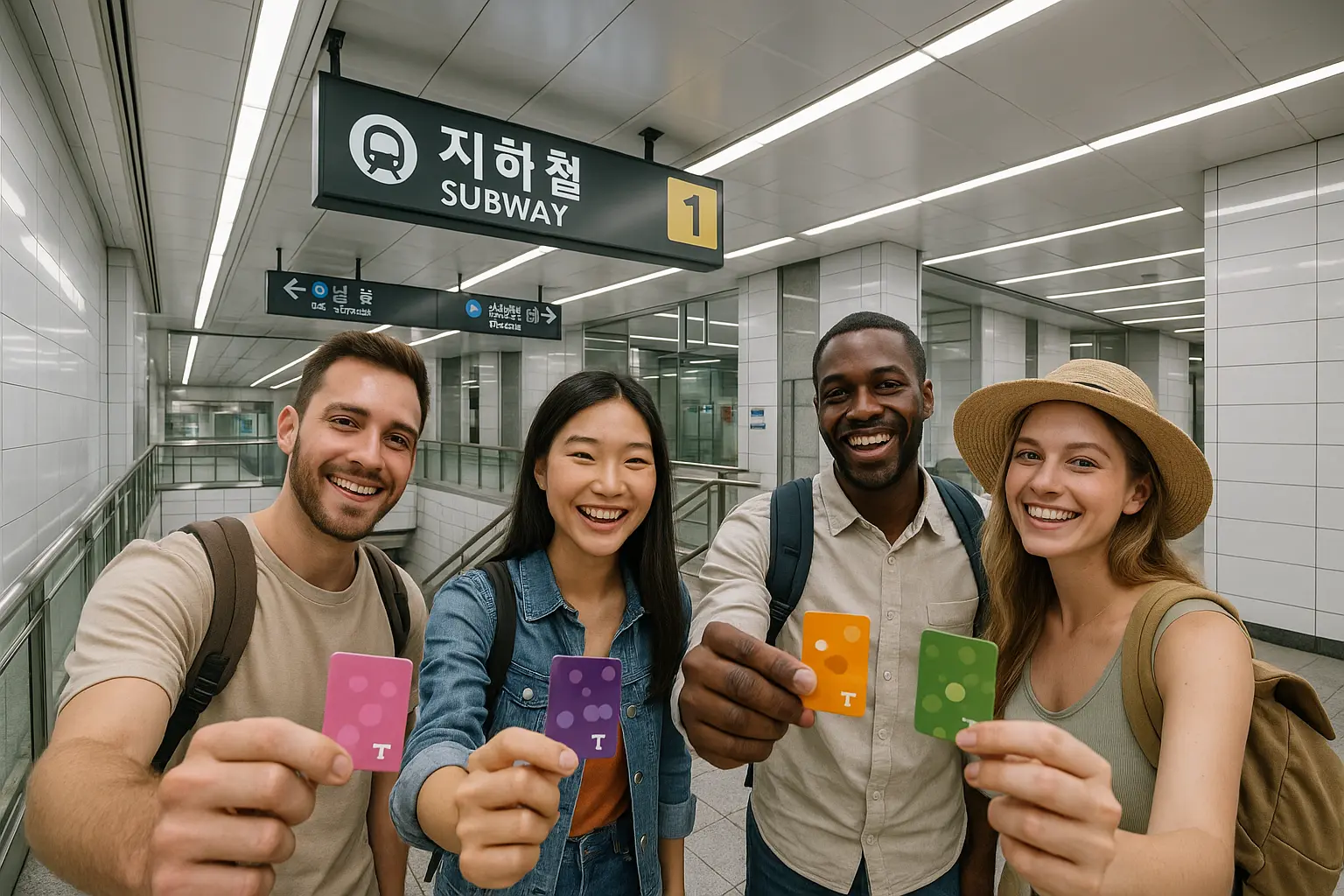
When I first arrived in Korea, transportation itself wasn’t the problem.
The subway was clean. Buses were everywhere. Everything looked organized. But the moment I had to transfer, choose the right exit number, or figure out my transportation card, I felt lost.
What confused me at first wasn’t just the language. It was how everything connected—subway to bus, bus to subway, and exits that mattered more than station names.
This guide is written to help you avoid those exact mistakes. Not to explain everything like a textbook, but to reduce stress, cut needless walking, and help you move around Korea with confidence from day one.
Updated for mid-2026 with the latest fare changes, the new Climate Card tourist pass, WOWPASS updates, and cashless bus policies that every visitor needs to know.
1. Understanding the Korean Transportation System (What to Use, and When)
Many foreigners I’ve met say the same thing: “I don’t mind using the subway—I just don’t know what I should choose in each situation.”
In Korea, the system itself isn’t hard. The confusing part is choosing quickly: subway or bus, bus or taxi, and whether a “simple route” is worth an extra walk. Once you have a few rules, your decisions get much easier.
Subway vs Bus vs Taxi: When to use each
- Subway — best when you want a predictable route with clear stations and signs. Base fare is ₩1,550 with a transit card (as of June 2025).
- Bus — best when your destination isn’t close to a subway station, or you want fewer walking minutes. Note: many Seoul bus routes are now cashless, so you must have a transit card.
- Taxi — best late at night, with heavy luggage, or when you’re truly unsure and just want to arrive. Standard base fare is around ₩4,800 in 2026.
When public transportation is actually better than taxis
In busy areas, taxis can feel slow because streets can get crowded. The subway keeps moving underneath everything. If you’re heading to popular neighborhoods, business districts, or major stations, subway-first is often the least stressful option.
Why exit numbers matter more than station names
What confused me at first was thinking exits were just “extra details.” In Korea, exit numbers often decide whether you walk 3 minutes—or 15.
A simple way to remember it: the station name gets you to the area, but the exit number gets you to the right corner.
2. T-money, Climate Card, or WOWPASS: Choosing the Right Card in 2026

The biggest change in 2026: you now have three strong card options instead of just one. Picking the right card before you land saves real money and hassle.
In 2025, T-money was the default recommendation for every visitor. In 2026, two newer options—the Climate Card and WOWPASS—have changed the game. Here’s how to choose.
T-money: Still the classic choice
The T-money card is the most universal transit card in South Korea. It works on subways, buses, and taxis across the entire country—Seoul, Busan, Daegu, Jeju, everywhere. You can also use it at convenience stores.
- Where to buy: Convenience stores (7-Eleven, CU, GS25), subway station vending machines, or airport stores.
- Card cost: ₩3,000–4,000 (empty; top up separately).
- Top-up: Cash at convenience stores or subway machines. As of March 2026, subway kiosks also accept foreign credit cards (Visa, Mastercard).
- Best for: Visitors traveling beyond Seoul (Busan, Gyeonggi-do, Jeju) or staying longer than a week.
Climate Card: The unlimited Seoul pass for tourists
The Climate Card (기후동행카드) is Seoul’s unlimited transit pass, originally launched for residents in 2024. Since mid-2024, tourist short-term versions have been available—and in 2026, they’ve become a genuine money-saver for active sightseers.
- Tourist pass options: 1-day (₩5,000), 3-day (₩10,000), 5-day (₩15,000), 7-day (₩20,000).
- Physical card fee: ₩3,000 (one-time purchase, reusable on future trips).
- What’s included: Unlimited rides on Seoul subways (Lines 1–9, plus Ui-Sinseol, Sillim, and Gimpo Goldline), Seoul city buses, and Ttareungi (Seoul’s public bikes).
- What’s NOT included: Sinbundang Line, subway rides ending outside Seoul (e.g., Incheon, most of Gyeonggi-do), red express buses, and airport buses.
- Where to buy: Subway station vending machines (Lines 1–8) or convenience stores near stations. Since March 2026, vending machines accept international credit cards.
- Best for: Visitors staying 1–7 days and exploring mainly within Seoul. The pass pays for itself at roughly 4 rides per day.
Important: The Climate Card only works within Seoul city limits. If you’re planning day trips to Suwon, Incheon, or other cities outside Seoul, you’ll still need a T-money card for those legs.
WOWPASS: The all-in-one card for tourists
WOWPASS has become almost essential for foreign visitors in 2026. With over 320 kiosks across Korea, it combines currency exchange, store payments, and a built-in T-money transit chip—all on one card.
- Card cost: ₩5,000–6,000 (includes T-money function).
- How it works: Load foreign currency (USD, EUR, JPY, and 13+ others) at bright yellow WOWPASS kiosks in airports, subway stations, and tourist areas. The kiosk converts it to KRW.
- Two separate balances: Shopping balance (for stores/restaurants) and T-money transit balance (for subway/bus). The transit balance must be loaded separately with KRW cash at convenience stores or subway machines.
- Best for: Tourists who want one card for both shopping and transit, plus easy currency exchange without visiting a bank.
Quick decision guide
- Short trip, staying in Seoul (1–5 days)? → Climate Card tourist pass.
- Longer trip or visiting multiple cities? → T-money card.
- Want one card for everything (shopping + transit)? → WOWPASS.
- Only taking 1–2 subway rides total? → Just buy a single-use ticket at the machine.
Common beginner mistakes with transit cards
- Not topping up enough and getting stuck at the gate.
- Assuming T-money is “subway only,” then paying cash on buses unnecessarily.
- Forgetting to tap out on buses (this is the most common mistake—and it costs you the transfer discount).
- Buying a Climate Card and then trying to use it outside Seoul.
- Loading currency onto WOWPASS’s shopping balance and expecting it to work on the subway (you need the separate T-money balance).
For official T-Money card information, please visit T-money official website. For Climate Card details, see the Seoul Metropolitan Government Climate Card page.
3. How to Use the Subway Without Getting Lost (Transfers + Exit Numbers)

Most people don’t get lost on their first subway ride. They get lost on their first transfer—when the corridor keeps going and they second-guess every sign.
Transfers in Seoul are usually logical once you slow down and follow signs. The biggest time loss comes from rushing, then realizing you walked into the wrong corridor.
Reading station signs as a foreigner
- Use line color + number — often faster than reading station names.
- Follow “Transfer / Transit” signs — don’t follow crowds blindly.
- Confirm direction by checking the final destination name on platform signs.
Transfer rules that confuse most newcomers
Many foreigners I’ve met worry they need to “tap again” during transfers. In most normal subway transfers, you do not tap out and tap in again. You stay inside the system and follow the transfer corridor.
Practical check: If you see gates, you’re probably leaving the system. If you see “Transfer” arrows and corridors, you’re staying inside.
Exit numbers explained (the part everyone struggles with)
Here’s the simplest way to understand exit numbers without any map image:
- Station name = the neighborhood.
- Exit number = the correct street corner.
- Wrong exit = longer walking. Not dangerous—just annoying when you’re tired.
If your app says “Exit 6,” treat it like a real instruction, not a suggestion. This single habit saves the most walking time for newcomers.
2026 subway fare reference
The base fare for adults using a transit card is ₩1,550 (up to 10 km). Beyond 10 km, an extra ₩100 is added for every 5 km. Single-use tickets cost ₩100 more per ride (₩1,650), plus a refundable ₩500 deposit. Teenagers pay ₩900 and children pay ₩550 with a registered card.
Live subway information is available at Seoul Metropolitan Transportation Authority.
4. Bus System Explained Simply (Colors, Tapping, and “Even Locals Get Confused” Moments)

If buses feel intimidating, you’re not alone. I’ve seen confident travelers freeze at a busy stop because five buses arrived at once.
The bus system becomes much easier when you focus on two things: bus colors and tap in & tap out. You don’t need to “master everything” on day one.
Blue / Green / Red / Yellow buses (what actually matters)
- Blue buses — major routes connecting key districts across Seoul.
- Green buses — local routes linking neighborhoods to subway stations.
- Red buses — express routes between Seoul and surrounding cities (Bundang, Ilsan). Fare starts around ₩3,000.
- Yellow buses — circulator routes in a smaller zone.
- N-buses (Night buses) — run from about 11:30 PM to 6:00 AM after the subway closes. Fare is around ₩2,500.
Cashless buses: What you need to know in 2026
Since 2023, many Seoul bus routes have gone fully cashless. This means you cannot board without a transit card on these routes—no coins, no bills. Always carry a T-money card, Climate Card, or WOWPASS before you plan to ride any bus.
How to tap in & out correctly (the one habit you must build)
- Enter through the front door.
- Tap your transit card near the driver.
- Press the stop button 1–2 stops before your destination.
- Exit through the back door.
- Tap again when you get off (this matters for correct fare calculation and transfer discounts).
Easy memory phrase: Front tap-in, back tap-out. If you forget to tap out, you lose the transfer discount on your next ride and may be charged the maximum distance fare.
Free transfers: The hidden money saver
When you tap out properly and transfer to another bus or subway within 30 minutes (60 minutes between 9 PM and 7 AM), the system calculates your total distance as one trip. That means you don’t pay a separate base fare—you only pay the additional distance beyond 10 km. Up to 5 free transfers are allowed per trip.
When buses are confusing even for locals
Yes—there are moments when even locals double-check:
- Stops with many similar bus numbers.
- Routes that look similar but go in different directions.
- Busy transfer hubs where multiple buses arrive together.
In those moments, your best move is simple: confirm the bus number in your app, then match it to the bus display before boarding.
5. Useful Apps for Foreigners (What Works in Real Life)
The fastest way to feel “stuck” in Korea: using the wrong map app, then blaming yourself for not understanding the city.
I won’t list “every app.” Instead, here’s what helps when you’re actually outside: choosing the right exit, deciding between bus and subway, and checking late-night options.
KakaoMap vs Naver Map: real-life differences
- KakaoMap — often feels intuitive for routes, nearby places, and street-level navigation. Integrates well if you use KakaoTalk (Korea’s main messaging app).
- Naver Map — strong for detailed place info and reliable local search. In 2026, it shows which subway car is closest to your transfer stairs (e.g., “Car 4-2”), which is incredibly useful.
Both apps have English interfaces in 2026. Either one will serve you well—pick whichever feels more comfortable after a few minutes of testing.
Why Google Maps often falls short in Korea
Many newcomers open Google Maps first because it’s familiar. But in Korea, it can feel incomplete for certain walking routes, transit details, or local address logic. That mismatch creates unnecessary confusion when you’re already tired.
Simple approach: Use KakaoMap or Naver Map as your main tool. Keep Google Maps as a backup reference.
Other apps many foreigners find helpful
- Kakao T — the essential app for hailing taxis. It supports English and shows upfront fare estimates, so you know the price before you ride.
- Subway Korea — a popular offline subway map app that shows lines, transfers, and estimated travel times. Useful when you lose signal underground.
- WOWPASS app — if you’re using WOWPASS, the app lets you check both your shopping and transit balances, freeze your card if lost, and find nearby kiosks.
- T-money GO — helpful for T-money related functions and checking your card balance (setup varies).
A note on Apple Pay and mobile transit
While Apple Pay works at many retail stores in Korea, using it for transit is still limited for foreign visitors in 2026. In-app T-money top-up currently requires a Korean domestic card. For most tourists, a physical transit card (T-money, Climate Card, or WOWPASS) remains the most reliable option.
For more transportation information, see the Seoul Transport Operation & Information Service (TOPIS).
6. Common Mistakes Foreigners Make (Quick Fixes + Mini Stories)
This is the section AI-style guides usually skip: the mistakes. Real travel is small mistakes and fast recovery.
If you only read one section when you’re in a hurry, read this. These are the exact mistakes I’ve seen repeatedly—because they’re easy to make when you’re tired or rushing.
Forgetting to tap out (especially on buses)
One mistake I see often is: people tap in, sit down, and exit without tapping out. It happens when you’re distracted or nervous. In 2026, this costs you more than before—you lose the transfer discount, and the system may charge the maximum distance fare.
Quick fix: If you notice while still on the bus, tell the driver. If you notice later, don’t panic—build the habit next time: front tap-in, back tap-out.
Taking the wrong exit and walking too far
What confused me at first was thinking, “Any exit is fine.” Then I would surface on the wrong side of a huge intersection and walk around it for no reason.
Quick fix: Check the exit number your app recommends before you leave the station. If you’re unsure, follow signs for the nearest landmark shown in your app.
Misunderstanding last train times
A common situation: you assume the subway runs late “like back home,” then realize you’re cutting it close. Seoul’s subway generally stops service around midnight (varies by line and direction—some last trains leave earlier).
Quick fix: When you head out at night, check the last-train info in your map app. If you’re not sure, plan a safer return using a late-night N-bus or a taxi (easily hailed through the Kakao T app).
Trying to board a cashless bus with only cash
This catches many visitors off guard in 2026. You step on the bus with coins ready, and the driver waves you off because the route is cashless.
Quick fix: Always get a transit card before your first bus ride. Buy one at any convenience store near your accommodation—it takes less than a minute.
FAQ – Frequently Asked Questions
Q1. I lost my T-money card, what should I do?
A: Call T-Money Customer Care at 1644-0088. If it’s a registered card, you may be able to transfer the balance to a new card. If it’s not registered, recovery can be limited. If you’re using WOWPASS, you can freeze the shopping balance immediately through the app (though the T-money transit balance may not be recoverable).
Q2. I’m lost on the subway, who should I ask for help?
A: Ask a station attendant for help. You can say “Help me please,” or simply show your destination on your phone. Many staff can assist with basic English.
Q3. I forgot to tag my card on the bus, what should I do?
A: If you notice while still on the bus, tell the driver. If you notice after you get off, focus on not repeating the mistake—tap-out is important for correct fare calculation and keeping your transfer discount.
Q4. What transportation should I use during late night hours?
A: The subway usually stops around midnight (varies by line and station). Consider a late-night N-bus or a taxi (use Kakao T for easy hailing), especially if you’re far from your accommodation.
Q5. I have a wheelchair or stroller, how do I access it?
A: Most subway stations have elevators, and many buses are low-floor. If you need help, station staff can guide you to accessible routes.
Q6. Should I get a Climate Card or T-money?
A: If you’re staying in Seoul for 1–7 days and plan to ride transit frequently, the Climate Card tourist pass saves money. If you’re visiting multiple cities or staying longer, T-money is more versatile since it works nationwide. You can also carry both—use the Climate Card in Seoul and T-money outside.
Korean phrases that actually help
- “도와주세요” (dowajuseyo) — Help me, please
- “여기가 어디예요?” (yeogiga eodiyeyo?) — Where am I?
- “지하철역이 어디예요?” (jihacheol-yeogi eodiyeyo?) — Where is the subway station?
- “이 버스 맞아요?” (i beoseu majayo?) — Is this the right bus?
- “얼마예요?” (eolmayeyo?) — How much is it?
Small reminder: If you’re stuck, showing your phone screen (destination + route) is often faster than explaining.
Wrapping Up: Your First 24 Hours Using Transit Like a Local

If you remember only three things, you’ll be fine: get the right transit card for your trip, stay calm on transfers, and treat exit numbers like real instructions.
Summary of key takeaways
- Transit card — choose Climate Card for Seoul-only short trips, T-money for nationwide flexibility, or WOWPASS for an all-in-one solution
- Transfers — follow signs; you usually don’t re-tap during subway transfers
- Exit numbers — the difference between “arriving” and “arriving easily”
- Buses — remember: front tap-in, back tap-out (many routes are now cashless)
- Apps — KakaoMap or Naver Map are usually more reliable than Google Maps for local navigation
- Fares — subway base fare is ₩1,550 with a card; tap out on buses to keep your transfer discount
Next step action plan (simple and realistic)
- Decide on your card: Climate Card (Seoul-only, unlimited), T-money (nationwide), or WOWPASS (all-in-one).
- Buy and top up at a convenience store or subway station as soon as you arrive.
- Try one simple subway route (no transfer) to build confidence.
- Try one transfer route slowly—reading signs on purpose.
- Do one short bus ride and practice tapping out.
Next steps after you feel comfortable using transit
After transit becomes easy, daily life becomes easier—food, neighborhoods, routines, and practical habits.
Want a deeper cultural feel? Food is the fastest path—here’s a practical guide that doesn’t assume special equipment.
Need more K-Life information?
Check out 365 Days of K-Life for more guides to living in Korea: