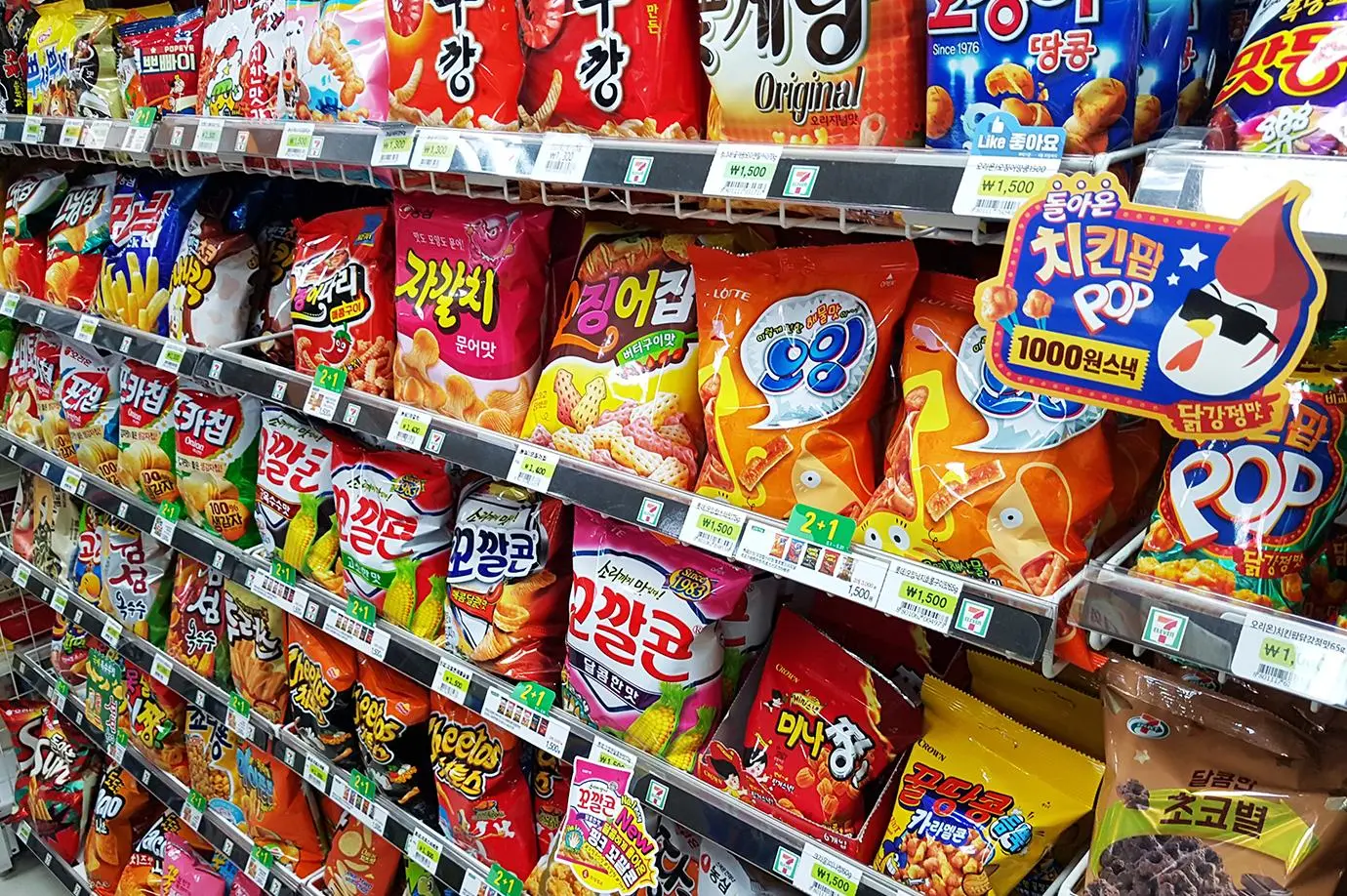
Summary: Korean snack exports shattered the $770 million mark in 2024, and the momentum shows no signs of slowing in 2026. Choco Pie, Kkobuk Chip, Honey Butter Chips, and Pepero are leading the Korean snacks global trend across American, Chinese, Southeast Asian, and now African and Indian markets—powered by the unstoppable K-food wave, $580 million in new factory investments, and South Korea’s ambitious goal of $16 billion in total food exports by year-end.
1. Korean Snacks Global Trend 2026: Why Is the World Still Obsessed?
The Korean snacks global trend in 2026 has entered a new phase of explosive growth, with the industry riding the coattails of a record-breaking K-food export year. South Korea’s total food and agriculture exports reached a historic $13.62 billion in 2025—a 5.1% increase from the previous year—and the government has set an ambitious $16 billion target for 2026. Within this booming landscape, confectionery exports alone hit an all-time high of $770 million in 2024, marking a 17.4% year-over-year increase, and industry analysts project snack exports will comfortably surpass $850 million by the end of 2026.
Global consumption patterns continue shifting dramatically. The U.S. remained the single largest importer of Korean agro-food products in 2025, with shipments rising 13.2% year-over-year to $1.8 billion. Meanwhile, Korean cuisine officially overtook K-pop as the most covered Hallyu category in North America, accounting for 26.7% of media coverage according to the Global Hallyu Trends Analysis. What started as a niche curiosity has become a full-blown cultural phenomenon—think of it as the snack equivalent of the BTS effect, except now it’s driven by animated blockbusters like KPop Demon Hunters and an ever-expanding retail footprint from Costco to Carrefour.
1. 2024 confectionery exports: $770 million (all-time record, +17.4% YoY)
2. 2025 total K-Food Plus exports: $13.62 billion (new historic high)
3. 2026 government target: $16 billion in total food exports
4. Korean cuisine surpasses K-pop as #1 Hallyu category in North America
2. Top 5 Korean Snacks Dominating International Markets (2026 Rankings)
The Korean snacks global trend in 2026 is dominated by five powerhouse products that have evolved from regional favorites into global household names: Choco Pie, Kkobuk Chip (Turtle Chips), Pepero, Honey Butter Chips, and Saewookkang (shrimp crackers). Orion’s Choco Pie remains the undisputed king—the company posted record sales of 3.1 trillion won ($2.19 billion) and 543.6 billion won in operating profit in 2024, surpassing the 500 billion won threshold for the first time in its history. In Vietnam, this marshmallow-filled chocolate treat has become so culturally embedded that families place it on ceremonial offerings—a status reserved for national staples. In Russia, over 1.6 billion Choco Pie units are consumed annually, pushing factory operation rates above 120%.
Kkobuk Chip has transformed from a rising star into a genuine global phenomenon. The snack recorded global sales of 83 billion won in 2025, with U.S. exports growing 35% year-over-year. It’s now available in over 30 countries across five continents, having expanded into Carrefour stores in France and SPAR supermarkets across South Africa in late 2025. Meanwhile, Pepero crossed a major milestone when Lotte Wellfood opened its first overseas production line in Haryana, India in mid-2025—the brand’s global sales already exceeded 200 billion won, and Lotte aims to build Pepero into a global top-10 food brand by 2035. Honey Butter Chips continues its steady reign at H-Mart across the U.S., while Saewookkang remains the nostalgic classic that introduces millions of newcomers to the world of K-snacks.
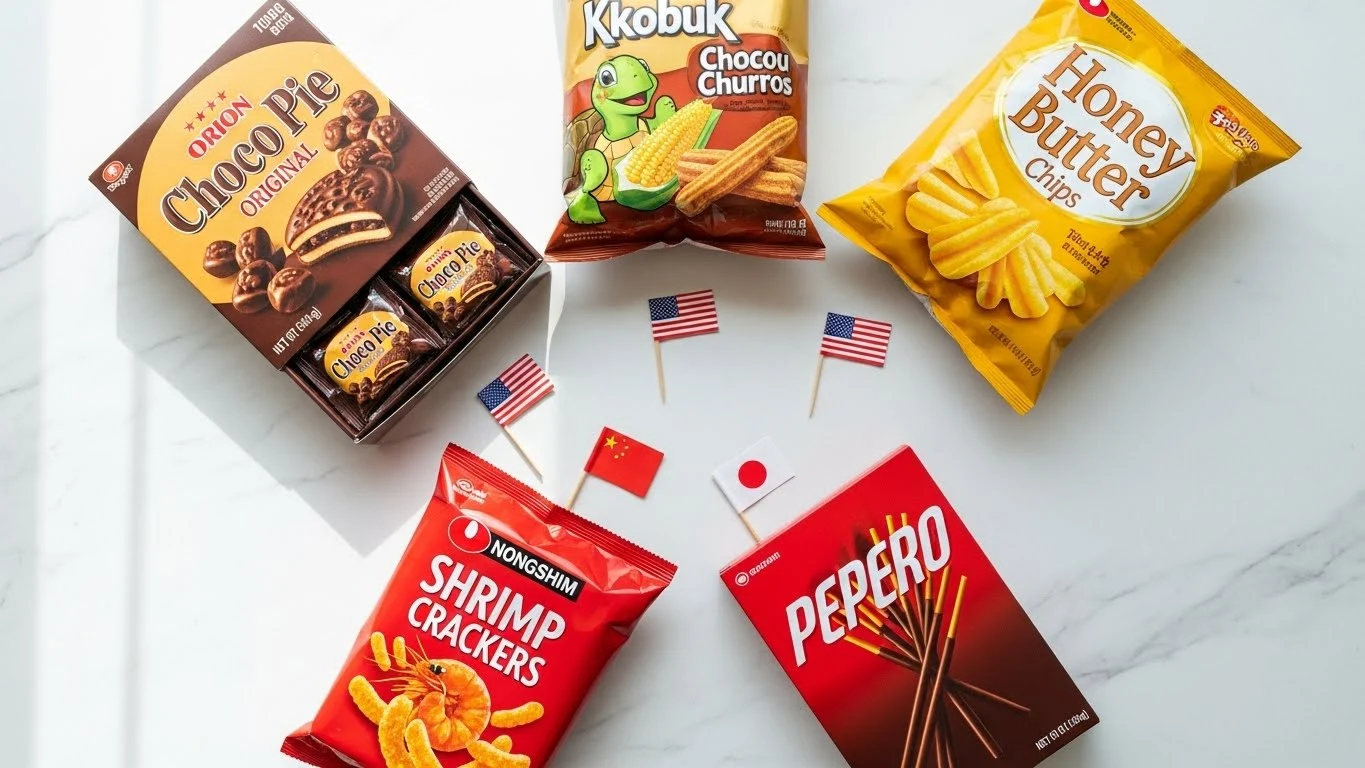
1. Choco Pie: Orion’s record $2.19B total sales in 2024, Russia factory at 120%+ capacity
2. Kkobuk Chip: 83 billion won global sales, now in 30+ countries across 5 continents
3. Pepero: First overseas factory opens in India, global sales exceeding 200 billion won
4. Honey Butter Chips: Steady #1 at U.S. H-Mart, expanding across Japan and Vietnam
5. Saewookkang: 9 million bags monthly, the gateway K-snack for first-time buyers worldwide
3. 3 Reasons the K-Food Craze Is Fueling Korean Snack Popularity
The first driver is the K-content multiplier effect, which has reached unprecedented scale. Netflix’s animated blockbuster KPop Demon Hunters prominently depicted Korean food, translating directly into consumer demand. Nongshim capitalized on this with character-themed Shin Ramyun packaging, and the ripple effects boosted snack awareness across the board. Stray Kids now serves as Pepero’s brand ambassador, with limited-edition packages flying off shelves globally. It’s similar to how Reese’s Pieces sales exploded after appearing in E.T., except this phenomenon happens continuously across multiple platforms—Netflix, YouTube, TikTok, and Instagram—creating a permanent marketing engine that costs Korean brands almost nothing.
Second is the perfect alignment with global health and flavor trends. The “swicy” (sweet-and-spicy) flavor profile has become a global sensation, driving Korean sauce exports to $412 million. Meanwhile, Korean snack brands have proven remarkably agile at trend adaptation—quickly launching matcha variants, zero-sugar options, and high-protein snacks to ride international hype waves. Lotte Wellfood’s new rice-based Ssallo Chip, launched in late 2025, exemplifies this diversification strategy. Consumers increasingly view Korean snacks as the “better-for-you” alternative to traditional Western junk food, thanks to lower-calorie formulations and innovative natural ingredients.
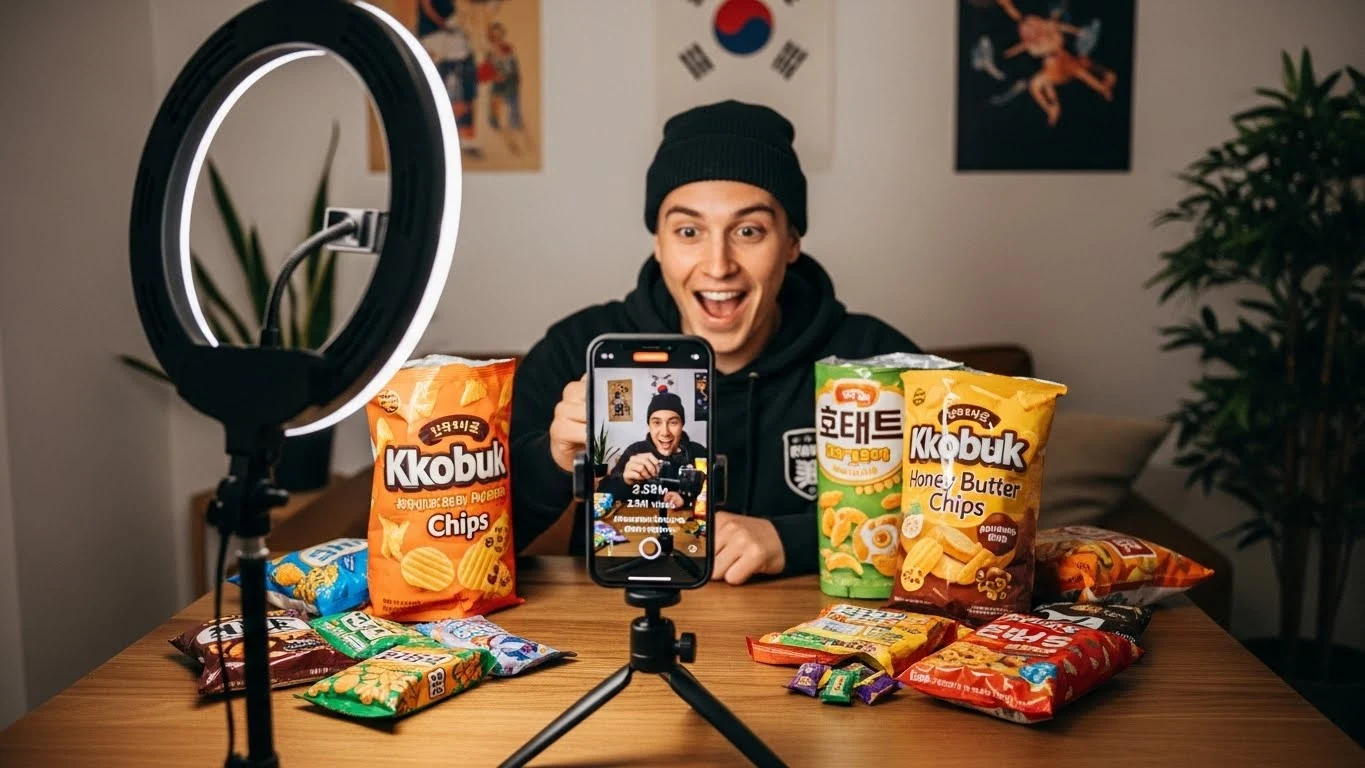
Third is the explosive power of social media viral marketing, now amplified by Gen Alpha joining Gen Z on these platforms. TikTok and Instagram Reels have transformed Korean snack challenges into global phenomena, with Korean snack-related hashtags accumulating billions of views. Whole Foods, Costco, and Trader Joe’s all expanded Korean snack SKUs in 2025, largely in response to consumer demand driven by social media discovery. The organic “snack haul” video genre—where international YouTubers taste-test Korean snacks—has become a content category unto itself, generating millions of views per video and creating an ever-growing funnel of new K-snack converts.
1. K-content multiplier: KPop Demon Hunters, Netflix, and K-pop brand ambassadorships
2. “Swicy” trend and health-conscious innovation meeting global flavor demands
3. TikTok, Instagram, and YouTube snack haul videos capturing Gen Z and Gen Alpha
4. 2026 Korean Snack Export Analysis: Country-by-Country Breakdown
Korean confectionery exports reached an all-time record of $770 million in 2024, and when combined with beverages, the total exceeded $1.3 billion. The United States dominated as the largest overall K-food importer, with total agro-food shipments reaching $1.8 billion in 2025—a 13.2% increase—while China followed at $1.5 billion (+12.5%) and Japan at $1.16 billion (+6.7%). Together, these three markets accounted for over 50% of all Korean food exports. Russia’s market showed particularly impressive growth as Orion’s factory there operates at 120%+ capacity, necessitating a planned 240 billion won ($169 million) expansion.

The truly exciting development in 2026 is the opening of new frontier markets. India, with its 1.4 billion population and a confectionery market valued at 17 trillion won ($12 billion), represents a massive growth opportunity—Lotte Wellfood’s new Pepero factory in Haryana began production in mid-2025, with plans to use India as an export hub for the Middle East and Southeast Asia. Africa entered the K-snack map when Orion launched Kkobuk Chip across 300+ SPAR stores in South Africa, marking the brand’s first African expansion. Government support continues accelerating growth: the Ministry of Agriculture signed $27 million worth of MOUs at the Buy Korean Food Plus fair in early 2026, drawing 143 buyers from 45 countries.
1. United States: $1.8 billion total K-food imports in 2025 (+13.2% YoY)
2. China: $1.5 billion (+12.5%), strong demand for localized flavors
3. Japan: $1.16 billion (+6.7%), stable and mature market
4. India: New frontier—Pepero factory in Haryana, Choco Pie already established
5. South Africa: Kkobuk Chip launches across 300+ SPAR stores
6. Russia: 120%+ factory capacity, $169M expansion planned
5. The $580 Million Factory Boom: How Korean Snack Makers Are Going Global
In April 2025, Orion announced the largest domestic food industry investment in five years: 830 billion won ($580 million) to expand manufacturing at home and abroad. The centerpiece is a massive new integrated production-to-logistics center at the Technopolis Industrial Complex in Jincheon, South Korea—covering 188,000 square meters (equivalent to 26 soccer fields), it will house production, packaging, and logistics under one roof when completed in 2027. The company’s goal is nothing short of transformative: achieving 5 trillion won in annual sales and 1 trillion won in operating profit.
But Orion isn’t the only Korean snack giant making bold global moves. Lotte Wellfood invested 33 billion won to build its first-ever overseas Pepero production line at its subsidiary’s Haryana, India factory, which became operational in mid-2025. The company aims for 1 trillion won in annual sales from India alone by 2032. Crown Haitai Group has also been expanding production capacity, opening a new factory for Crown Confectionery in Asan, South Chungcheong Province, with plans to position a factory near the Port of Pyeongtaek as an export hub. This factory construction race signals a fundamental shift: Korean snack companies are no longer simply exporting from Korea—they’re building a global manufacturing network to serve local markets directly, just as Japanese and American snack companies did decades before them.
1. Orion Jincheon Center: 460 billion won, completion 2027, capacity up to 2.3 trillion won
2. Orion Russia expansion: 240 billion won, doubling capacity to 750 billion won annually
3. Orion Vietnam expansion: 130 billion won, meeting surging Southeast Asian demand
4. Lotte Pepero India: 33 billion won, first overseas Pepero factory, operational 2025
5. Crown Haitai Asan factory: New production hub for Honey Butter Chips exports
6. 3 Ways to Buy Korean Snacks Anywhere in the World
The first option is online platforms. Amazon, Coupang Global, and H-Mart’s online store make purchasing Korean snacks effortless from almost anywhere in the world. Amazon offers popular products like Choco Pie, Honey Butter Chips, Kkobuk Chip, and Pepero with Subscribe & Save options, with average delivery times of 3-7 days. Prime members often get free shipping, making it the most convenient choice for American consumers. For a deeper dive into K-food delivery, check our comprehensive Korean delivery app guide for foreigners.
Second is visiting brick-and-mortar retail locations, which have expanded dramatically. Major U.S. chains including Walmart, Costco, Target, Whole Foods, and Trader Joe’s now feature dedicated K-food sections—all of these retailers expanded Korean snack SKUs in 2025 in response to surging consumer demand. European retailers like Carrefour (France) and Selfridges (UK) stock growing Korean snack selections, while Five Below carries Kkobuk Chip across all 1,598 U.S. locations. The newest frontier is Africa, where SPAR supermarkets in South Africa now carry Kkobuk Chip in three flavors across 300+ stores in Cape Town and Johannesburg.
Third is Asian grocery chains and specialty stores. H-Mart operates dozens of stores throughout the United States with the most comprehensive Korean snack selection available offline. In the UK, Wing Yip and Korea Foods carry extensive ranges, while Asian supermarkets in Germany (Go Asia), France (K-Mart Paris), and Australia offer growing selections. For those living in Korea, convenience stores like CU, GS25, and 7-Eleven stock the latest limited-edition flavors that haven’t even reached export markets yet—perfect for discovering the next viral K-snack before it goes global.
1. Online: Amazon, Coupang Global, H-Mart online, Weee! (US), Seoul Plaza (UK)
2. Major retail: Walmart, Costco, Target, Whole Foods, Trader Joe’s, Carrefour, SPAR
3. Asian grocery chains: H-Mart (US), Wing Yip (UK), Go Asia (Germany), Korean convenience stores
7. Frequently Asked Questions (FAQ)
Choco Pie leads with Orion recording record $2.19 billion in total sales for 2024. Kkobuk Chip is rapidly expanding with 83 billion won in global sales and presence in 30+ countries. Pepero opened its first overseas factory in India, while Honey Butter Chips maintains its #1 spot at U.S. H-Mart stores.
The United States ranks #1, importing $1.8 billion worth of Korean agro-food products in 2025, a 13.2% increase. China follows at $1.5 billion and Japan at $1.16 billion. Together, these three markets account for over 50% of all Korean food exports.
Amazon, Walmart, Costco, Target, Whole Foods, and Trader Joe’s all carry Korean snacks in the U.S. In Europe, check Carrefour and Selfridges. H-Mart offers the widest selection across its U.S. locations, and in South Africa, SPAR now stocks Kkobuk Chip in 300+ stores.
Three main factors drive popularity: K-content exposure through Netflix, K-dramas, and K-pop brand ambassadorships; health-conscious formulations that align with global “swicy” and natural ingredient trends; and viral social media marketing through TikTok and Instagram that costs brands almost nothing but generates billions of views.
Three key trends are shaping 2026 and beyond: massive factory investments ($580M from Orion alone) to build a global manufacturing network; expansion into frontier markets like India, Africa, and the Middle East; and product diversification with zero-sugar, matcha, and protein-focused snack lines tailored to local market preferences.
Korean confectionery exports grew from $431.4 million in 2018 to $770 million in 2024—nearly doubling in six years. South Korea’s overall food exports hit $13.62 billion in 2025, with the government targeting $16 billion for 2026. The industry is on track to surpass $850 million in snack exports alone by year-end 2026.
8. Related Reading and Reference Materials
Related Articles
1. Korean Delivery App Guide: Complete Comparison of Baedal Minjok & Coupang Eats for Foreigners
2. Reborn Rich Miyeokguk Recipe – K-Drama Birthday Seaweed Soup Tradition
3. Hotel Del Luna Korean Table Setting Recipe – Traditional Meets Fusion K-Food
4. Crash Landing on You Kimchi Stew Recipe – North Korean-Style Dish That Captivated 190 Countries
5. Seaweed Exports Hit New Record: $997M in 2024, Leading K-Food Superfood Revolution
Reference Sources
1) Korea Agro-Fisheries & Food Trade Corporation (aT), Monthly Export Statistics Database
2) The Korea Times, “Korea’s Food Exports Hit Record High in 2025”, January 12, 2026
3) BusinessKorea, “Korea’s Confectionery Imports Rise to an All-time High in 2024”, February 5, 2025
4) KED Global, “Orion to Invest $580 Million in New Plants”, April 16, 2025
6) KED Global, “Lotte Wellfood Launches First Overseas Pepero Production in India”, July 7, 2025
7) Outlook Respawn, “K-Food Boom 2026: South Korea Targets $16B in Exports”, April 28, 2026
Additional Resources (YouTube & Social Media)
1. YouTube search: “Korean snack haul 2026” – International YouTuber Korean snack review and taste-test videos
2. TikTok hashtags: #KoreanSnacks #KSnackTrend #TurtleChips – Global consumer reactions and viral challenges
3. Instagram hashtags: #KoreanSnacks #KFood #ChocoPie – Real-time trend monitoring and product discoveries