
Bottom line: Korea autumn foliage in 2026 starts on the high ridges of Seoraksan in late September, peaks across most of the country between mid-October and mid-November, and finishes in Seoul’s ginkgo-lined streets in the second week of November. Plan around three separate colour waves, not one.
1. When Korea autumn foliage peaks in 2026
Here’s the thing most travel guides get wrong: Korea autumn foliage isn’t one weekend. It has a six-week rolling wave that starts on the granite ridges of the northeast and finishes on the ginkgo avenues of downtown Seoul. Get the wave right and you can see peak colour twice in one trip.
The long-term trend matters for anyone timing Korea autumn foliage in 2026. Research from Seoul National University and the Korea National Arboretum published in 2026 found that peak foliage has slipped later by roughly a third of a day per year over the past 16 years — about five days in total. Warm Septembers now routinely push the whole calendar back. Treat every date below as a centre point with a five-day cushion on either side.
| Region | First colour | Peak window | Headline spots |
|---|---|---|---|
| Gangwon | Late September | Oct 12–22 | Seoraksan, Odaesan |
| Chungcheong | Mid-October | Oct 24–Nov 2 | Songnisan, Woraksan |
| Gyeonggi / Seoul | Mid-October | Oct 28–Nov 15 | Bukhansan, Seoul parks |
| Jeolla | Late October | Nov 3–12 | Naejangsan, Seonunsa |
| Gyeongsang | Late October | Nov 1–10 | Jirisan, Gayasan |
| Jeju | Late October | Nov 1–10 | Hallasan |
1) First colour: when roughly 20% of the summit area has changed
2) Korea autumn foliage peak: when 50% or more of the mountain has turned — it holds for about 7–10 days
3) Afterglow: good colour usually lingers for two more weeks at lower elevations
One planning caveat worth repeating: the official Korea Forest Service and Korea Meteorological Administration forecast for Korea autumn foliage is published in mid-September, not before. The table above is a booking framework built on climate trend data — check the official numbers once they land, then fine-tune.
2. The 10 best Korea autumn foliage spots
These are the Korea autumn foliage destinations that consistently deliver, ranked roughly in the order they turn. Prices and access details below were verified for the 2026 season.
🏔️ Seoraksan National Park (Gangwon)
Peak: Around October 12–22
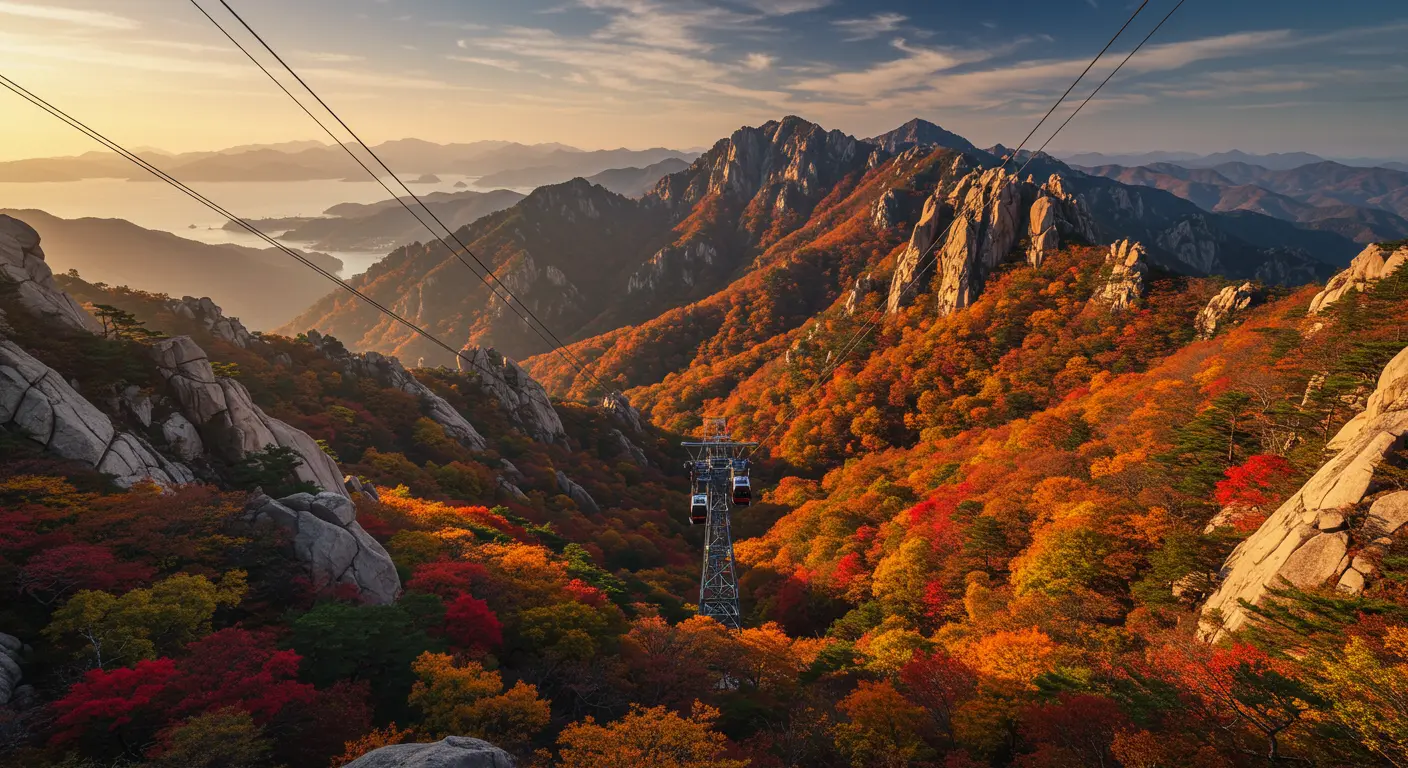
Why go: The opening act of the Korea autumn foliage season. Jagged granite spires, Ulsanbawi Rock, and the view from Gwongeumseong Fortress — think Yosemite compressed into a coastal massif.
Route: Sogongwon → Gwongeumseong cable car → Biseondae → Cheonbuldong Valley
Cable car 2026: ₩16,000 adults / ₩12,000 children, round trip only. There is no online booking — tickets are same-day, on-site only, because high winds stop the line without warning.
Getting there: Express bus to Sokcho, then a local bus to the park entrance
🍁 Naejangsan National Park (Jeongeup, Jeonbuk)
Peak: Around November 3–12
Why go: Nicknamed the “Geumgangsan of Honam.” Its native aegi-danpung — a small-leaved maple — packs colour so densely that the 1km approach road becomes a red tunnel.
Route: Ticket gate → maple tunnel → Uhwajeong Pavilion → Naejangsa Temple
Costs 2026: Park admission is free; parking runs about ₩5,000. The cable car to the Yeonjabong observation deck is roughly ₩11,000 return, on-site sales only.
Bonus: The maple festival now rolls straight into a winter light festival at the same site, running from late October into January.
🌄 Jirisan National Park (Gyeongnam / Jeonbuk / Jeonnam)
Peak: Around November 1–10
Why go: The most serious Korea autumn foliage hiking in the country, across its largest mainland park. Piagol and Baemsagol valleys are the classic colour corridors.
Route: Piagol Valley → Nogodan Ridge → Cheonwangbong (multi-day for the full traverse)
4) Odaesan National Park: the fir-lined approach to Woljeongsa Temple, flat and stroller-friendly
5) Bukhansan National Park: Seoul’s own mountain — Baegundae and Insubong, reachable by subway and bus
6) Songnisan National Park: Beopjusa Temple plus the switchback view from Maltijae Observatory
7) Gayasan National Park: Haeinsa Temple, home of the Tripitaka Koreana woodblocks
8) Hallasan National Park: Jeju’s only true foliage mountain — summit trails need a free advance permit
9) Juwangsan National Park: rock spires and pools; the most photogenic small park in the country
10) Gyeryongsan National Park: the quiet Donghaksa–Gapsa temple traverse near Daejeon
3. Easy autumn day trips from Seoul
No car, no problem. These Korea autumn foliage spots are all reachable on public transport, and several of them peak in mid-November — a full month after the mountains, which is exactly why Seoul is a smart late-season base.
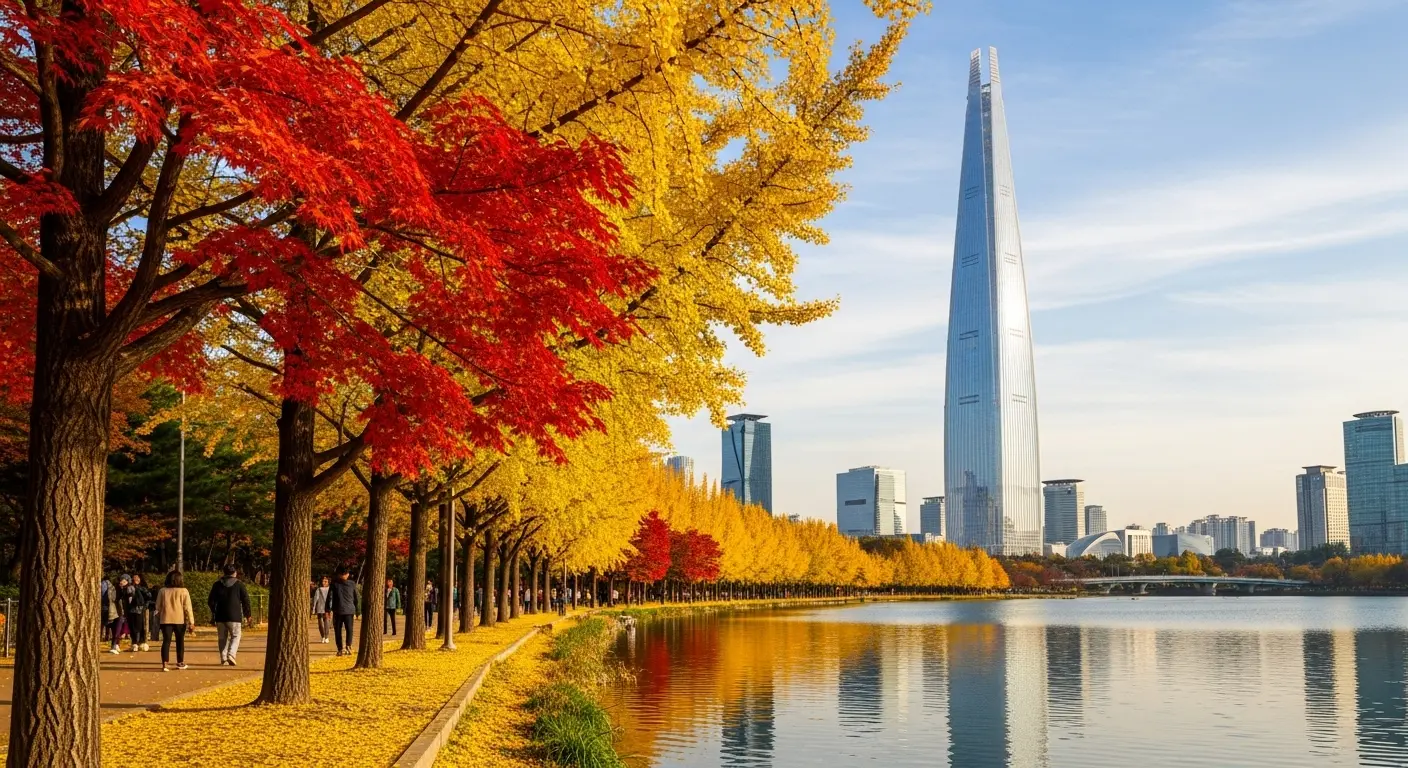
1) Seokchon Lake (Jamsil, Line 2/8): lakeside colour framed by Lotte World Tower
2) Seoul Forest (Ttukseom, Line 2): the ginkgo grove is the city’s most reliable golden shot
3) Namsan Park circuit: N Seoul Tower above a maple-lined loop trail
4) Yangjae Citizens’ Forest (Sinbundang Line): family favourite, wide flat paths
5) Soyosan (Line 1 terminus): a real mountain valley, straight from the station exit
Two things changed the near-Seoul picture since our last update, and both are worth building a day around.
🌲 Hwadam Botanic Garden (Gwangju, Gyeonggi)
Peak: Late October to mid-November
Why go: A curated 4,300-species arboretum where a looping monorail carries you to the top of the colour. It is the single most photographed autumn spot within 90 minutes of Seoul.
Booking: 100% advance online reservation, with a daily visitor cap and no on-site ticket sales. Autumn slots sell out fast, so book the moment the season opens.
Costs: Admission ₩11,000 adults / ₩9,000 teens and seniors / ₩7,000 children; monorail return ₩9,000 adults, ₩7,000 children. Open 09:00–18:00, last entry 17:00, closed Mondays.
Getting there: Gonjiam Station (Gyeonggang Line), then a 10-minute taxi
If crowds are the thing you most want to avoid, skip the famous names entirely. Wondae-ri Birch Forest in Inje trades maples for 70,000 white birch trunks and golden leaves, and Gwanbangjerim Forest in Damyang pairs riverside colour with early-morning fog and evening illuminations. Both stay quiet even on peak weekends. Pair either with a mountain wellness stay in Gangwon and the trip stops being a checklist and starts being a rest.
4. How to plan the trip in 2026
The Korea autumn foliage calendar has two pinch points this year, and both fall inside foliage season. Domestic travel surges hard around them — trains, buses and mountain-town accommodation sell out weeks ahead.
| 2026 date | Holiday | What it means |
|---|---|---|
| Sep 24–27 | Chuseok | Four-day national exodus; avoid intercity travel |
| Oct 3 & Oct 5 | National Foundation Day + substitute | Three-day weekend, early colour in Gangwon |
| Oct 9 (Fri) | Hangeul Day | Long weekend, near-peak at Seoraksan |
1) Book the cushion, not the date: reserve refundable rooms for the week around your target peak, then commit once the September forecast lands
2) Start at 07:00: access roads to Seoraksan and Naejangsan clog badly from 09:00 on peak weekends
3) Chase the rain: colour is most saturated two or three clear days after a rainfall
4) Check trail closures: the Korea National Park Service closes a share of trails each autumn for wildfire prevention, typically from early November — confirm your specific route before travelling
5) Layer up: ridge temperatures run 5–10°C below the valley, and Seoraksan often sees its first snow in late October
6) Split the day: famous spot in the morning, quiet temple or valley in the afternoon
5. Entry rules, costs and apps for 2026
Two entry-procedure changes affect anyone flying in for Korea autumn foliage this season, and both are easy to get wrong.
K-ETA: Korea’s Ministry of Justice has extended the temporary K-ETA exemption through December 31, 2026, so nationals of the eligible visa-free countries can enter without applying. Applying anyway is optional and costs ₩10,000.
e-Arrival Card: If you don’t hold a valid K-ETA, you must submit the digital arrival declaration online within three days before landing. Paper forms are gone.
1330 helpline: Korea’s tourism hotline runs 24/7 in English and seven other languages — genuinely useful when a cable car closes for wind.
Apps worth installing: Naver Map or KakaoMap for navigation (Google Maps is limited in Korea), Papago for translation, and Korail’s app for KTX seats.
Budget for a mountain day trip from Seoul in 2026: roughly ₩30,000–60,000 (about US$22–44) for round-trip intercity transport, ₩0 for national park admission, ₩11,000–16,000 if you ride a cable car, and ₩10,000–15,000 for a temple-town lunch. A two-night Seoraksan trip lands near ₩250,000–350,000 per person including a mid-range room — and autumn is the one season where paying up for a mountain-view room genuinely earns its keep. If food is half the reason you travel, our guide to Korea’s food-first travel boom pairs neatly with a foliage route.
6. How to photograph autumn leaves
Photographing Korea autumn foliage doesn’t need a camera body worth more than your flight. Modern phones handle autumn light well — the difference is entirely in timing and position.
1) Work the golden hours: the hour after sunrise and the hour before sunset, every time
2) Shoot into the light: backlit maple leaves glow translucent red — the single biggest upgrade to your shots
3) Pair wide with tight: one full-mountain frame, one close-up of a single branch
4) Find water: reflections in a temple pond or valley stream double the colour
5) Shrink the human: a small figure in a large frame reads as scale, not as a selfie
6) Turn off auto-HDR: it flattens exactly the contrast that makes foliage look rich
7. Frequently asked questions (FAQ)
Q1. When is the official 2026 forecast released?
A1. Mid-September, from the Korea Forest Service and the Korea Meteorological Administration. Book flexible accommodation before then and lock in specific dates afterwards.
Q2. If I can only come for one week, which week?
A2. For Korea autumn foliage overall, the last week of October covers the most ground — Seoraksan is still holding, central Korea is peaking, and Seoul’s parks are turning. For city-only trips, aim for November 5–15 instead.
Q3. Which spots work without a car?
A3. Seokchon Lake, Seoul Forest, Namsan and Soyosan are pure subway trips. Seoraksan connects by express bus to Sokcho, and Hwadam Botanic Garden is a short taxi from Gonjiam Station.
Q4. Do I need to reserve anything in advance?
A4. Hwadam Botanic Garden is reservation-only with a daily cap, and Hallasan’s summit trails require a free permit. The Seoraksan and Naejangsan cable cars are the opposite — same-day, on-site only.
Q5. What does a foliage trip cost?
A5. National park admission is free at every Korea autumn foliage park. A day trip from Seoul runs about US$22–44 in transport plus optional cable car and meals; a two-night mountain trip sits near US$180–260 per person.
Q6. How does it compare to cherry blossom season?
A6. It lasts far longer. Blossoms give you 7–10 days nationwide; Korea autumn foliage gives you six weeks, with clearer skies and more comfortable hiking temperatures.
8. Related Reading
Discover more guides to enjoy Korean K-Travel in depth.
- 1) Korean Gourmet Travel: Why “Good Food Trips” Became the No.1 Tourism Trend
- 2) Hidden Gems of Korean Wellness Tourism: Healience Seonmaeul & Mountain Healing in Gangwon
- 3) Jjimjilbang Survival Guide: Everything Foreigners Love About Korean Bathhouses
- 4) Jeju Healing Travel Guide – A 3-Night, 4-Day Nature & Wellness Experience
- 5) How to Beat the Korean Summer: Unique Valley “Cold Therapy” Spots
9. References
2) Korea National Park Service (English) – Park-by-park trail conditions, reservations and seasonal closure notices
3) Seorak Cable Car — Official Site – Live operating status, fares and the same-day ticketing policy for Gwongeumseong
4) Hwadam Botanic Garden — Official English Site – Advance-reservation rules, monorail timetable and visitor notices
5) Korea Tourism Organization — K-ETA Exemption Extended to 2026 – Official notice on entry authorisation and arrival declaration rules
🔎 Check live conditions before you go
Korea autumn foliage timing moves. These official pages are the ones locals actually refresh during the season:
🌲 National Park trail status 🚡 Seorak cable car live status 🎟️ Hwadam booking (EN)📸 Instagram hashtags: #KoreaAutumn #KoreaFallFoliage #Seoraksan #Naejangsan #AutumnInKorea #VisitKorea #KoreaTravel
💡 Korea Autumn Foliage 2026: Key Takeaways
1) Best Korea autumn foliage window: mid-October through mid-November
2) Peak targets: Seoraksan (Oct 12–22), Naejangsan (Nov 3–12), Seoul (Nov 5–15)
3) Suggested shape: two nights at Seoraksan → Seoul park days → one southern mountain
4) Pack: layers, trail shoes, power bank, T-money card, light rain shell
5) Budget: US$22–44 per day trip, US$180–260 for two nights per person
6) Avoid: Chuseok (Sep 24–27) and the Oct 3–5 long weekend for intercity travel
Found this useful? Share it with whoever you’d want beside you on a maple-lined trail. Here’s to a spectacular Korean autumn in 2026.